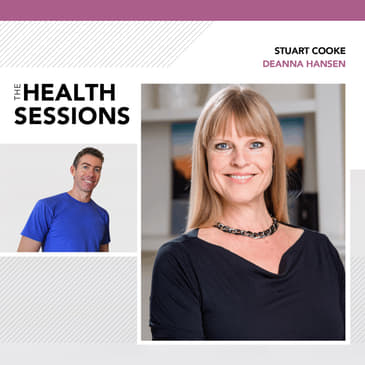
This week I'm excited to welcome Deanna Hansen to the podcast.
Deanna is a Certified Athletic Therapist and founder of Fluid Isometrics™ and Block Therapy™, a bodywork practice that is meditation, exercise and therapy all in one.
In this episode, we discuss the importance that fascia plays where pain and tension are concerned and dig deep into the fundamentals of block therapy and so much more.
As a gift for our listeners, Deanna is offerring free access to her 9 Part DIY Fascia Sampler Series:
Download your free 9-Part Full Body Fascia Video Series ($47 value) and learn positions to open the flow to improve oxygenation to cells, as well as strengthening exercises to pull your body back into optimal alignment.
Fascia Sampler Series: https://blocktherapy.com/sampler-program-opt-in/
Website: https://blocktherapy.com
Stuart Cooke (00:01.329)
Hey guys, this is Stu from the Health Sessions and I am delighted to welcome Deanna Hansen to the podcast. Deanna, how are you?
Deanna Hansen (00:07.777)
I'm great. Thank you, Stuart. How are you?
Stuart Cooke (00:09.559)
Very well, thanks. First up for all of our listeners that may not be familiar with you or your work, I'd love it if you could just share a little bit about yourself, please.
Deanna Hansen (00:18.892)
Yeah, so I've been doing this work in fascia decompression now for just over 26 years. Back in the late 80s, 90s, I was going through university to become an athletic therapist here in Canada. That's like physiotherapy, but we were trained to work specifically with athletes. And I was doing all of the work I was trained to do, but my own personal body was not responding well. was 50 pounds overweight, struggling with anxiety, depression, chronic pain. And the harder that I was putting the time and energy into my body, the worse
I became the more compressed, the more toxic I became. At the age of 30, created or I made some big changes to my life that created.
Serious anxiety attacks and it was this one anxiety attack in particular that really became the seed of everything to come for me in the moment I actually thought I was gonna die because I was literally so held in fear. I couldn't catch my breath So for some reason I intuitively dove my hand into my abdomen and the first thing that I encountered was pain But the pain brought me out of my crazy thinking it brought me back into my body I knew I was breathing so I continued to explore with my hands in the tissue now prior to this
that as an athletic therapist, I always focused on deep tissue work. So I was really good at locating scar tissue and understanding it in other people's bodies. But because I stored so much of my size in my belly, I really hated this area. I never touched it. And now here I am diving into it. And what I found so remarkable was it was marbled with what felt like scar tissue, even though I hadn't had any injury or surgery. Suddenly I had all these aha moments. Like no wonder when I'm coming home from a
mile run dripping what was sweat my belly would still feel cold. So after that first evening of working 30-45 minutes what was really notable was how calm I felt and then
Deanna Hansen (02:10.26)
The next day I was a little tender from the work, but that tenderness actually kept me present in my body and I was really excited to get back home that second evening and continue exploring. And after the second night of doing that similar work, when I stood up, I felt taller and I went and I looked at myself in the mirror and my belly was flatter than it had looked in years. And I mean, when I was working hard, I was going all out. I was doing 400 sit-ups a day, running, Tae Bo, weights in the gym, dieting. And again, like the harder I worked, the worse I became.
So to have such a dramatic result in literally two days, this became my new approach to working on my own body after I'd work on my patients all day. Within two weeks, my chronic low back pain was going away, my neck pain was improving, but most importantly, my outlook on life changed significantly. And at that time, I started flipping my patients onto their back and I started working in a very similar fashion in their bodies. And it wasn't long before I started attracting other therapists to learn what I was doing because
the results were so amazing for them. So that was 26 years ago and about 10 years after that began, that was when I started creating block therapy, which is the self-care version of the technique that I developed so people could learn how to do it for themselves.
Stuart Cooke (03:26.385)
Fantastic. Well, that's a fascinating story. And I've got a million and one questions about block therapy, but I just wanted to jump in and talk about fascia first, just to provide some context to everything that you're going to outlay with us today. So fascia typically isn't a word that is used as commonly as maybe strength training and cardio and stretching and the like. So in simple terms, what is fascia?
And why does it play such a big role in pain and tension?
Deanna Hansen (04:00.652)
So yeah, and it's interesting because in 2007 I went to the world's first fascia conference. It was held at Harvard, but I found that so interesting because I mean back in, I think it was the seventies, the rolfing technique was present and myofascial release with John Barnes was already out in the world. So now the medical community is saying, Hey, we're having the world's first fascia conference. it was quite an interesting moment, but definitely now that word has become a bit of a buzzword in the world, but I still don't
feel people have a really good understanding of this tissue. It's getting better but I literally see it as the cell membrane of every cell connecting every other cell. So it's the communication system in the body and there's a number of components but it's primarily comprised of two proteins, collagen and elastin. So the collagen is that structural protein. The elastin of course gives us the ability to move freely and when they're in balance we have optimal space in and around every
cell. Space allows for ease of absorption of nutrients in as well as the removal of toxins and debris and even negative emotion away from the cell. And if that's our situation, our body is flowing with ease and theoretically there shouldn't really be any issues if that's the case.
However, that's not the reality because we are under this constant force of gravity. We're dominant on one side. We have the accumulation of how we've used our body throughout our lives adding up to this moment. So are you slouched over in front of your computer hours a day? Do you do physical labor? Do you play a sport that might be really rotational? Do you play an instrument? Are you in a stressful environment? What do you eat? I mean, all of these things add up to create our current scenario. And so what ultimately happens
is as we start to tip off balance, which happens because again gravity and the asymmetry pulling us down, it's that collagen protein that starts to migrate to areas of need so we don't fall flat on our face. So as it continues to accumulate over time, essentially these are what the adhesions are in the body, these proteins will grip and adhere to everything in their path including bone with a force up to 2,000 pounds per square inch, sealing us.
Deanna Hansen (06:16.01)
magnetically in these negative alignments. So this is really the situation that people are dealing with is basically we are shorter and wider, we're compressed, we have cells that are starving and dirty, and we're simply not functioning well. So to understand how to support the fascia system, it's really about putting the space back into the body that time has taken away through fascia decompression, which is what my work is all about.
Stuart Cooke (06:41.031)
Well that's fascinating. Is there any connection, and just a curveball question just occurred to me as you mentioned collagen and elastin, is there any connection in the foods that we eat to support fascia and I'm thinking predominantly this whole trend of collagen supplementation.
Deanna Hansen (07:00.27)
Absolutely the foods that we eat matter because the proteins in the foods become the building blocks for our body. So we want to eat healthy foods and we want to eat clean food because I mean, again, which, is a very hard to do these days. We're in such a toxic environment. So it's even more important now to really understand how to support your fascia and keep your lymphatics flowing. But I'm all for like eat, eat clean, but also listen to your body. You know, some people thrive eating meat. Some people are great with a vegetarian diet.
Stuart Cooke (07:07.473)
Yeah.
Deanna Hansen (07:30.254)
diet, but it's really about how you feel. There's different body types and different things, but food is definitely a factor.
Stuart Cooke (07:36.239)
Okay, fantastic. So then, how do we support our fascia, which would roll into then block therapy? So I'm really intrigued to understand what block therapy is and the problems that it solves.
Deanna Hansen (07:50.007)
So there's three pillars that make up this work. So essentially as we go through time, we compress, we become shorter and wider. And again, ultimately what's happening is we're losing that internal space and then our flow slows, we become stagnant and sluggish and toxic like me when I was back in my 20s. So what this work is all about, the first pillar is creating the space we've lost through time. And that's all about
finding those areas of density, spending time with them to magnetically release the bind that they have at the bone level so that we can start to pull those collagen proteins back to correct alignment. And we do that with tools. So this is called the Block Buddy. This is the Block Baby. So in my starter program, there's two sizes of blocks. And how we use this is we are lying on the tool throughout all parts of the body, but no matter what, we always start
Stuart Cooke (08:40.122)
Mm-hmm.
Deanna Hansen (08:49.712)
first lying on it right on the belly button to teach people how to breathe diaphragmatically, which is the second pillar and these two pillars work together. So pressure over time creates heat and that heat allows us to start melting through those adhesions that are blocking flow and then teaching people how to breathe diaphragmatically we start pumping blood and oxygen into these newly created spaces so these cells that are suddenly
up, they start to absorb that oxygen and then they become part of the equation of how we utilize our body. And then the third pillar is all about maintaining proper alignment so that we don't continue to fall into those negative patterns and just cycle. We want to basically pull people back into that alignment so that we can put the space back into the body that time has taken away through these three pillars. And when we have a moment, I'd love to dive deeper into the significance of diaphragmatic breathing because it's really, in my opinion, of the three pillars. The reason
that we're doing all of this other work is to teach people how to breathe.
Stuart Cooke (09:53.073)
Yeah, well if you want to jump into that now because one of my questions was obviously breath seems to be so fundamental to everything that we do and oftentimes linked to inflammation and a whole host of other issues for the body. So tell me what your thoughts are on the proper use of breath.
Deanna Hansen (10:10.092)
Yeah, so the diaphragm is a plate of muscle that rests at the base of the rib cage. When we inhale, this plate of muscle moves down. When we exhale, it lifts. So if this muscle is working properly, the organs, the heart and the lungs, they're getting a continual mechanical massage, which puts energy into the body. Also, when we're breathing consciously, the muscle is strong. So everything above it has a proper foundation to support it.
The though, pain, fear and stress cause you to reactively hold the breath. And unlike a deer who survives an attack will shake and move the energy, that negative energy that came in out of the body, we as humans, we have some kind of an assault, whether physical, emotional, mental, spiritual, whatever it is, and reactively we hold the breath. And then we don't tend to release it. We stay frozen in that locked breathing pattern and then age from there, causing the body to have to pattern so that we don't
tip over. And what's so important to understand is when we are breathing with the diaphragm, we're pulling the air deeply to the base of the lungs where the majority of the oxygen receptor sites reside. We feed the body up to 600 % more oxygen when we're breathing diaphragmatically. But for the person that's breathing that shallow upper chest breath, you know, we're only pulling the air so far into the lungs so we don't reach.
where the majority of those receptor sites are. So we don't have that optimal absorption. Also, they've shown that 84 % of weight loss comes through proper exhalation. And I was thrilled. I think it was around 2014 when all of this information started coming out. There's a TED talk about it. And that took me back to when I was in my 20s and I'm working out like crazy and I'm dieting. And yet it was like the rules of weight loss don't apply to me because I kept getting more compressed and bigger.
Stuart Cooke (11:41.629)
Yeah.
Stuart Cooke (12:01.415)
Ha
Deanna Hansen (12:04.238)
But I was recognizing because I also started yoga at the same time and every 30, 45 seconds, this instructor would remind us to breathe and I'd be holding my breath. So that became such an integral component to the understanding of me developing this work. And even when we're breathing diaphragmatically, our brain frequency is in a relaxed state. We're in that parasympathetic mode, which is what we need for rest and rejuvenation. We should be parasympathetic 80 % of our day. But if you're breathing through the muscles of the upper chest,
people are living in sympathetic even when they're sleeping. So they're never getting that regeneration after the assault of the day. We should be able to go to sleep and reset but we're not resetting. So we continue to go through this degradation over time which isn't necessary if we can learn how to turn back on this powerful muscle. And then the last thing I want to talk about the diaphragm is if we are breathing through the muscles of the upper chest now this muscles weak. So
This takes me back to when I was a dancer in my teens and everybody said hold your belly in but if I'm holding my belly in I'm being forced to breathe up here. So now this muscle over time as it weakens now the weight of the upper body starts collapsing into the core.
Stuart Cooke (13:11.484)
Right.
Deanna Hansen (13:19.412)
And now we expand outwardly because tissue has to go somewhere. So many people feel after they hit a certain age, they haven't changed anything, but now they're getting that spare tire. They think that they're increasing fat. It's not fat, it's compression, ballooning, and then the toxic environment that results from that lack of flow that's causing that expansion.
Stuart Cooke (13:41.755)
Wow. That I think that that that last sentence that you said, it's not fat, it's compression. Blooming will probably be one of the little clips that will gain the most attention to attract people to listen to this podcast. That is fascinating. So how, like, how do we, how do we tackle our breath? If we are not sure whether we're breathing in the right way, because I've spoken to Wim Hoff and he has a strategy on there. I've done lots of apnea training for free diving.
and I know that there are different ways to attack the breath and there are a myriad of different box breathing and we don't know where to start there. I mean, a little bit like nutrition, we've got all of these different philosophies of the way to eat. How do you tackle the correct way to breathe?
Deanna Hansen (14:29.08)
So the most important thing, and this comes back to that 2,000 pound per square inch seal of the fascia that we end up getting sealed in magnetically, even the rib cage gets involved in that. if, again, this plate of muscle, we need the space in the core of the body in correct alignment in order for that to be the case, but that's nobody's situation because I always look at the feet first when I'm assessing a body. We're always going to have one foot drawing away from the body, kind of like a flat tire.
And then the other side anchors to keep us stable. Because we're dominant on one side and we don't really understand how to be balanced in the body, that's the natural progression, whichever way it is. Most people fall to the right because they're right side dominant.
The adhesions in the feet and the hands and the top of the head are where we are anchored most strongly because these are the areas furthest from your diaphragm. Your diaphragm could be looked at as like an engine or your body's furnace. When it's working properly, we're heated appropriately. I live in a building, I'm in Winnipeg. It can be sometimes minus 35, minus 40 Celsius in the winter. And if I only have a space heater, I can heat one
Stuart Cooke (15:39.669)
wow.
Deanna Hansen (15:44.373)
room. Upper chest breathing is like having a space heater for your body. If I'm breathing diaphragmatically it's like you're turning on the building's furnace and then you can heat the entire building. So because the extremities are the furthest from this muscle this is where we get sealed magnetically with that most incredible force. So even if say you have a frozen shoulder and you go for shoulder treatments the second you start walking and getting pulled back into that negative alignment
all of the work that you just did there, it's going to be negated by the fact that the feet are really the biggest driver of our alignment. So to understand cause sites to pain and issue sites is one of the most important things about this work. So that again, we're not just running in circles to try to get to some end that we will never find. So again, the diaphragm, because it gets collapsed and held, it's like it's a frozen shoulder, but it's a frozen diaphragm. And I mean, you can have a total frozen shoulder.
or you can have some mobility and it's still considered a frozen shoulder. So same with the diaphragm. We might have a little bit of that muscle working, but again, those upper chest muscles are doing the majority of the work. So the first thing that we do to address it is to work through the rib cage and the core to release those adhesions to bring more of that muscle into play.
And that's the first thing because all of the breath work that people are doing, if we don't release it, you might only be getting 10, 20, 30 % of that muscle working for you. We want that whole plate working on our behalf. So that's the first thing. And then the second most important thing is we teach people to focus further on the exhale than the inhale. I always say exhale for a count of six, inhale for a count of four. You can even exhale for longer, but that ups the carbon dioxide in the blood. And the carbon dioxide is a necessary
component for the oxygen to leave the hemoglobin and enter the cell, which is of course where we want the oxygen to go in the cell. So if we're low in carbon dioxide, we can have all the oxygen running through the body that we want, but it's not going to get delivered to the cells. So those are the two things that we focus on from a breathing perspective. And then because, again, the limbs become ultimately the puppet masters of the core, we address the full body and very much so the
Deanna Hansen (18:01.486)
feet are one of the biggest areas that we teach people to work on to bring that third pillar, their proper alignment back into play.
Stuart Cooke (18:11.323)
And I'm assuming when you're talking about those strategies, you're referring to block therapy or block therapy techniques. Fantastic. So tell me then, keen to understand essentially what block therapy is and how it is different from things like, say, massage, stretching, foam rolling, and all of these different techniques that you can purchase and sit on and...
Deanna Hansen (18:17.09)
Yes. Yes.
Stuart Cooke (18:40.273)
golf balls for the feet and things like that.
Deanna Hansen (18:42.582)
Yeah, so from the perspective of self-care modalities, because this is a self-care modality, there's a few things that really make it unique. And number one is the actual tool. I have a factory here in Winnipeg and these are made out of reclaimed elm. So bone and wood are similar in density. And because those adhesions will grip to bone with that 2000 pound per square inch seal, we need to melt through the layers of fascia.
through all of those adhesions to get to the root at the bone. So we're not moving on the surface either. We plant in an area, we stay there for a minimum of three minutes. Pressure over time creates heat on the surface and then we're turning on that internal furnace, the diaphragm. So we're heating the body from the inside and the outside. And because we are teaching people how to shear.
through the layers instead of moving on the surface. It's like you're deep sea diving instead of taking a boat on the surface of the ocean. The fascia rollers, all those other things where you're rolling on the surface, you'll get some benefit to the surface layers, but that's not where the root of the issues are. So this essentially goes deeper because of that. And again, that focus of really opening up the diaphragm first and teaching people about that exhale being longer than the inhale, that does increase that carbon dioxide so that we're getting way more opportunity
for those areas that we're opening now, for those cells to be able to receive that oxygen effectively and become part of the equation of how your body is being driven.
Stuart Cooke (20:13.381)
It sounds fascinating. I'm sure people will liken that to the manipulation of deep tissue via massage, etc. And their question will be, well, I did that and boy, was it painful. I don't ever want to go back there because it hurt so much. What does a typical session look like and is there pain involved in this release process?
Deanna Hansen (20:38.722)
So there's only two rules in block therapy. The first one is your breath is your guide. As long as you're breathing in a relaxed way, you're feeding and healing the body. You're in that parasympathetic mode, which is where we need to be in order to actually heal properly. So first of all, you're in control. Nobody's doing something to you. And because bone and wood are similar in density, they actually love each other. They're really good friends. And the pressure fibers in the body are larger than the pain fibers.
Stuart Cooke (20:44.753)
Right.
Deanna Hansen (21:08.676)
get into a position, we are instructing you how to get in and how to connect to your breath in a safe way. And then suddenly any pain that you're feeling, starts to change because those pressure fibers are kicking in. And then we teach you actually to become pain seekers. Pain is simply like the baby crying. The problem with pain is there's a pain fear cycle. We have pain we don't understand. We're afraid we hold the breath. We hold the breath. We have now that frequency in the brain creating fear.
Stuart Cooke (21:20.913)
Right.
Deanna Hansen (21:38.629)
We feel more fear. We hold the breath even further. We have more pain because we have less oxygen getting to the cells. So by teaching people how to move into pain on purpose in a conscious way that they have control over and then feel and see the immediate benefits, it takes that fear out of the equation. So pain is now simply a sensation. Again, like the baby crying, your cells are giving you information that they're needing something, whether it's hydration, nutrition.
space, rest, all of the things that we as a human need to feel good. then it basically, again,
pain becomes the driver. And when we're doing this work, we're not adding pain to the body. We are making you aware of the pain that's deeper than what you're consciously aware of so that we can pull it up to the surface and then exhale it out of the body in order that we go deeper. So it becomes a lifestyle and it's quite addicting because the first thing people sense after doing that belly position is that state of calm, which is so atypical for most people.
Stuart Cooke (22:46.045)
How long a session and talk about the duration, is this a daily regime? Is this something that we might do first thing in the morning, last thing at night, before gym, after gym, or is it connected to the gym in any way? What would that regime look like?
Deanna Hansen (23:08.212)
And that's the beautiful thing about this. really, because you get the tool sent to you, you do it in the comfort of your own home when time allows. I have a number of programs and the majority of classes and guidance that I give is about a 30 minute class per day. And then there might be a three to five minute alignment training. But even if all you did was the very first position that we share for three minutes on the belly, that's gonna change how you breathe and it's gonna change how you feel. As far as when is it appropriate,
it. You know some people, whenever it fits into your day basically, you know lots of people love doing it before the gym because it again it creates that that feeling of relaxation. It opens up the body's flows and then you can go and you can work out.
but also it repairs the body after a workout. So the stiffness will be far less and you will recover that much faster. really it comes down to everybody intuiting what works best for their own body. And the more you do the work, the more intuitive you become. Most of my members, this is their lifestyle. This is an exercise of therapy and a meditation all wrapped up into one. So it often replaces other things, but it's also a beautiful compliment with
anything. So you can pair this with your workouts or with a yoga practice or with acupuncture or essential oils or whatever it is that you're doing for your own health. This opens up the channels for flow. So even if you're taking some kind of a supplement, if that medicine can't get to the cell, then it's not doing you any good. And those adhesions block the ability for things to get to the destination. So this again, this helps the flow in general.
Stuart Cooke (24:47.826)
Hmm.
Stuart Cooke (24:51.527)
Yeah, okay, very, very interesting indeed. if I'm working, let's say I'm working on the very base principles of block therapy and I'm understanding for the first time the importance of breath and I'm feeling the difference between full diaphragmatic breathing as opposed to shallow breathing. And then I go to the gym and I'm just gonna use, let's say, bench press, for instance, just to throw that in as an example. The first thing I do on a bench press is,
I'll get well after I've got my grip ready, I'll breathe in and I'll hold my breath. Should I look at that strategy in a different way? Because in let's say resistance training, which is being touted as being perhaps one of the most important things to do as we age to become less fragile. Should I be thinking about this?
I'm going to hold my breath and I'm going to lock everything down and then I'm going to start lifting weights or should I be thinking about using the breath in a very different way and breathing through these exercises?
Deanna Hansen (26:00.749)
That's a great question. you know, so many people, they put their back out because they lean forward, they lift something too heavy, they hold their breath as they lift. And when we're holding our breath, now we're asking ourselves to work, but we're starving them. So I always share with people, whenever we're going to be doing any kind of physical activity, you want to exhale with the harder portion of the action. So I would be exhale as you're lifting, inhale as you bring the arms back down and so on and so
Stuart Cooke (26:10.258)
Hmm.
Deanna Hansen (26:31.652)
But I have a very different viewpoint. I mean, I used to be the one in the gym. could, you know, for a woman, like I had the 45 pound plates in the bar and I could do like three rounds of 10 bench presses, but I was massive. again, I was trying to get small and all it did, like I remember there was a moment in time when my mom said, Deanna, your head is too small for your shoulders. And I'm like, this is not the goal that I want. And I'm thinking in my head, the more muscle mass, the faster I'll burn fat. But you know what? That didn't work.
Stuart Cooke (26:40.189)
Yeah.
Right.
Stuart Cooke (26:50.455)
crikey. No, yeah.
Stuart Cooke (26:59.462)
Right.
Deanna Hansen (26:59.5)
Because ultimately what happens is when we are doing concentric repetitive contraction, we are working in the groove that we've created.
Stuart Cooke (27:09.425)
Yeah, of course.
Deanna Hansen (27:09.878)
what we want to do ultimately, especially as we age to keep our metabolism high and in fact to increase metabolism, we want to make sure all of the cells in the body are working. But if we only have 10 % or 20 or 30 % of our diaphragm functioning, we're only feeding that percentage of cells in the body with oxygen. So if you had a hundred people that were recruited to do a job, but only 20 of them were actually doing the work, those 20 people are going to fatigue.
pretty quickly because the other 80 are just kind of slugging around. That's what's happening to the body when we're not integrating all of the cells with oxygen. So through this process of releasing adhesion throughout the entire body, we're opening up those channels to make those cells previously blocked to awaken and to become part of the equation. Most people are living in survival mode.
Your toe cell and your heart and brain cells are equally important when it comes to thriving. When it comes to survival, your body is going to direct the energy to the organs necessary for survival and systematically shut down what you can handle.
Stuart Cooke (28:24.541)
Mm.
Deanna Hansen (28:24.918)
to survive. But that's where people are living and that's how we ultimately what's happening when we're aging. We're systematically slowing down our body cells are getting less and less activated as part of that equation. But with this work we recruit those cells we bring them back online so now they're functioning for us. That increases metabolism now you've got more cells needing energy.
your metabolism gets higher, you're stronger for it. Again, being in parasympathetic, you're sleeping better, so you're regenerating better. So it's such a different concept. And I mean, as an athletic therapist, again, I was trained, you know, weights and all the stuff, but I don't buy that anymore as being the healthiest way to age.
Stuart Cooke (29:08.155)
Yeah, well I guess it's a very important part of a very big, well a much bigger machine and if, like you said, if we're focusing just on this one thing there will be an imbalance at some point in time, has to be. For those people then wanting to understand more about block therapy, like what does it mean, like how do I get started? I'm living in Australia, you're in Canada, obviously I can't come and see you, how does that work?
Deanna Hansen (29:38.403)
Well, this is a self-care modality. So we actually have a free gift for your listeners where it's a nine class program. We work the whole body. We teach you how to breathe. We open up the rib cage. We get to the foundations and using a rolled up towel. We teach you how to roll it up so it's nice and dense. And the key with this, we want something that's dense. It's not...
Stuart Cooke (30:02.713)
Mm-hmm.
Deanna Hansen (30:03.434)
as dense as the block. It's not going to do the same thing, but it's really pretty good and it will teach you the fundamentals of what this work is all about. So you can really get a sense of how this feels and that alone will change your life if you just do this nine-part program because again it's all about teaching you how to breathe and that's the most important thing. That as well as releasing the extremities. just starting there is a fantastic place to start and then if you love it, my website is blocktherapy.com
you can order my starter program, which is where we always recommend people to start. And again, you can choose both blocks, one or the other. We always say if you're over five feet tall, get the big one. If you're under five feet, the little one. But I've got a membership with hundreds of hours of classes. And I have lots of classes where we do double blocking to make it really efficient. Also,
Some positions that we teach, one might feel better for you than the other. The little guy might be more intense in some areas, it might be less intense than others. So it's lovely to have both if you can, but that's the lovely thing. You order the tools, we get them sent to you and then everything you have access to immediately through our online portals.
Stuart Cooke (31:14.279)
Fantastic. Okay, well what I will do is we'll put all those details for our audience in the show notes so they can access that and jump on board and start to explore. So I'm guessing your travel bag probably looks quite different to everybody else's. Do you travel with blocks? Yeah, it's probably a good marketing tool as well, think. Yeah, people go, I need to know what that is. Well, let me give you the elevator pitch. it's fantastic.
Deanna Hansen (31:27.054)
I do. I do. Yeah, I always bring this one on the plane with me.
Deanna Hansen (31:40.014)
You
Stuart Cooke (31:42.589)
So one simple practice our listeners can implement today to start improving their body, and this is pre-sign up, so they've perhaps signed up to your course, they haven't even opened it yet, but if you could give them just one simple tip, trick or strategy to start them on their journey, what might that be?
Deanna Hansen (32:01.662)
this is my favorite one.
I'm going to dive in and talk about the feet a little bit here because again, I mentioned the feet are really the anchors to our whole alignment being that foundation. If they're not aligned, nothing up the chain is aligned. So that means managing size and shape. Do you have cellulite? Do you have chronic pain? Do you have disc disease? Are you storing trauma in your body? Are you aging too quickly? Are you acidic? Do you have fatty liver disease? I mean anything and everything.
that is wrong in the body, fascia is a component and your feet are going to be a major part of that. So a great thing you can do is you can use a finger, a pencil or a chopstick, anything like that. You put pressure between each toe. Hold for three minutes as you focus on that exhale. So it's a great little exercise to do if you're watching a TV show or something. And then what happens is you start repatterning the toes.
Stuart Cooke (32:54.481)
Yeah. Yeah.
Deanna Hansen (33:01.536)
when we fall out of alignment, the toes start losing their connection to the ground. They're supposed to be like talons, right? Like they're supposed to be nice and strong. They support balance. They help us be mobile. Most people really aren't using their toes anymore when they're standing and being mobile. And what happens is because now we're, it's kind of like we're walking on clubs and we're patterning away from the body. The body in general has to contract to stop you from tipping over.
So that creates all of those tensions. And then as that 2000 pound per square inch seal gets locked into the feet, it's creating that anterior pelvic tilt for the majority of people. That's creating compression in the back, which can create, you know, the discs to shoot out the back pressure on the nerves. It pulls the upper chest or pulls the chest forward and down, compressing the organs, the heart and the lungs. So we really want to support the feet and doing that exercise every day has
changed people's lives. And what happens after we do it, so again, it can take say 20 more minutes, 24 minutes if you're going to work between every toe. And then after you do it, I always say to people, if you have like three more minutes, stand in front of a mirror, grip your toes and take 10 slow exhalations. And that might only take you one minute, but think that you're pumping up the tires. We want to have a spring in our step. The majority of people are walking on flat tires and they've now proven the connection to longevity and toe strength.
because as people age typically past 70 years old, they don't really have much of their toes working for balance. And if you fall at that age and you fracture a hip, that will change your life span very quickly. So making sure that your feet are strong and connected to the earth supports the energy channels and the alignment up the chain.
Stuart Cooke (34:43.675)
Mm.
Stuart Cooke (34:52.797)
That's fascinating. tell me what your thoughts are on modern day footwear, because I know that we'll play into this in a big way.
Deanna Hansen (34:57.954)
Yeah.
Deanna Hansen (35:01.612)
Yeah, I'm a barefoot girl. You know, I'm barefoot as much as I possibly can be. yeah, I mean, I've never even owned a pair of high heel shoes in my life. So again, we should have 60 % of our body weight on our heels. The average person has more than 80 % on the balls of their feet. And that's before putting on a shoe with a heel. And then if you imagine like, you know, the stiletto shoes that are pointed or any toe box that's squishing the toes, the...
Stuart Cooke (35:03.322)
Right.
Stuart Cooke (35:25.883)
Yeah.
Deanna Hansen (35:27.982)
The ball of the foot should actually be broader than your heel. So shoes should reflect that. And that doesn't mean that they're pretty, but you know what, when it comes down to feet, your feet are the most important outside of your diaphragm. I would say the feet are the most important area to take care of next. And you wanna be able to have your feet planted on the ground. So shoes are an issue for sure.
Stuart Cooke (35:51.611)
Yeah.
Deanna Hansen (35:52.525)
And they've got barefoot shoes and zero shoes and like all these other things are coming out now. And that's great if they work for you, but that's the thing. We don't want to squeeze our feet and manipulate proper alignment of the feet because that guaranteed that's going to create things like headaches and shoulder pain and
a bloated belly and people don't connect those things together so much because they're such a distance away and we don't even really consider the feet unless you're getting a pedicure or you have pain. Otherwise we don't think of the feet.
Stuart Cooke (36:23.089)
Yeah, it is fascinating. I've been wearing barefoot shoes for decades and it just, feeling that splay of your toes when you're standing and you can feel each individual toe has enough room is, it's quite profound, especially if you ever gravitate to a conventional narrow set of training shoes which feel like your feet are bound together. It just feels completely wrong. And I guess when you,
Deanna Hansen (36:27.882)
nice.
Deanna Hansen (36:51.394)
Well, and then how does that change how you move, right? When your feet are down, you're not moving with that free flow that you would have otherwise had.
Stuart Cooke (36:54.426)
Exactly right.
Stuart Cooke (36:58.939)
That's right, yeah, it's part of balance and balance is key to longevity, I guess, because like you mentioned, if we fall and we're fragile, then potentially it's game over, especially in our older years. Yeah, very interesting indeed. So tell me, we're slowly coming up on time, but I'm keen to understand a little bit more about your own...
Deanna Hansen (37:13.928)
Great. Yeah.
Stuart Cooke (37:27.421)
personal practices in terms of non-negotiables, things that you do each and every day to enable you to live your best life. And it doesn't necessarily have to be connected to block therapy or fascia or any of those things. It might be that sunlight is super important to you or hydration or mindset and movement, all of those things. What do you do from perhaps the time that you get up in the morning to the time that you go to bed?
in order to just feel vibrant and winning the day each and every day.
Deanna Hansen (38:00.927)
Great question Stuart and I give myself that first hour for sure to me And I will start with my morning meditations. First of all, I'll start lying in my bed with my block I've got my blocks in my bed. So Before I even move it's under my belly. So I'm waking up and I've got that nice breath work happening Then I'll do my morning breath work meditation
Stuart Cooke (38:13.532)
Yeah.
Deanna Hansen (38:24.086)
make sure that I, you know, I'll use, I use activation products. That's the brand and it's, you know, the iodine and whatever. So I'll make sure I'm getting like the important minerals that I need. And then once I feel like my life and my day are settled, I'll have my bath. And then I also do one of the other techniques called the tongue decompression technique every morning where I align the jaw appropriately. Cause again, head being also furthest from the diaphragm. It's another factor that we want to look after. So I do a lot of fascial decompression.
compression work on my own body as my non-negotiable before I start my day. And then, then I go to the workspace where, which I love. But I don't wake up with that phone in my face because that's going to set me off in a negative way. And I used to wake up and it was like, let's get all of my work out of my way first. And I've changed that. It's like, no, no, I'm more important than anyone else. And we should all believe that for ourselves, right? Not in an egotistical way, but if we look after ourselves first, then we
Stuart Cooke (39:08.551)
Yeah.
Stuart Cooke (39:16.593)
Yeah.
Deanna Hansen (39:23.8)
be the best version for everyone. If we're looking after everything else before ourselves, then we can't give our best. So there's that selfishness that is necessary to be the most selfless person, I believe. Yeah.
Stuart Cooke (39:37.981)
Yes. Yeah, completely. No, I understand. I guess I always think of the airplane when the oxygen cylinders or the oxygen mass pulled down and the sit and look after yourself first, because then you're more useful to everyone else. No, exactly right. No, that's great. And so for anybody that wants to understand, then learn more about you.
Deanna Hansen (39:51.374)
Yeah, you don't want to die. Then you can't help anyone.
Stuart Cooke (40:07.909)
your journey, your practices, sign up for courses, order blocks, where can we send them?
Deanna Hansen (40:14.922)
So my website is blocktherapy.com and there's tons of information on there. I have countless educational videos on my Block Therapy YouTube channel. I have a book on Amazon called Unblock Your Body, How Fascia Decompression is the Missing Link in Healing. And probably my most favorite place to send people is my private Facebook community group, Block Therapy Community. Everybody is welcome. We have 25,000 members now. And what's so lovely about that place, I really
feel this is why we were able to grow the way that we did because
with all of those people in there. have two moderators that answer the questions, but I have such a beautiful community that supports everybody. for example, if you have MS or Parkinson's or you've had chronic pain for 20 years and you ask questions, you're going to have people that have done the work sharing their experiences with you. So it's not just me saying, sure, this works for all these things. It's people that have had those issues going through it that are there to give you that support and that understanding. Because one thing
healing crises, I like calling them healing opportunities, they're real.
And you know when we start disrupting the status quo, the negative energy has to go somewhere and it's going to come out and how is it going to come out? It could be mucus production, it could be a fever, it could be a change in pain, skin rash, emotional outbursts, memories coming to the surface. Like all of these is your body's way of bringing up what's been stuck inside so that can come to the surface so we can allow it to leave and become that cleaner version of ourselves. So having that support system is so important.
Deanna Hansen (41:53.2)
important and you can ask any question in there and again you're just going to have such a beautiful support system to assist you with the information as well as the process.
Stuart Cooke (42:02.567)
Fantastic, that's fantastic. will put all those links that you've mentioned today in the show notes. But Deanna, it's been a joy to speak to you. really, yeah, I want to learn more. I'm fascinated by it and we'll certainly be sharing your message today with our audience and hopefully they will too. Thank you so much for your time.
Deanna Hansen (42:19.853)
Great. Thank you so much, Stuart. It's been a pleasure. Bye.
Stuart Cooke (42:22.717)
Thank you, bye bye.