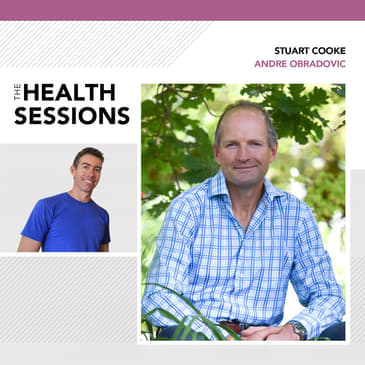
Andre Obradovic is an ICF Leadership PPC Level Coach, A Primal Health Coach, a Certified Low Carb Healthy Fat Coach, & a Certified Personal Trainer. Andre is also a Founding member of the Dr. Phil Maffetone MAF certified Coach. He is an Ambassador for the Noakes Foundation, and a regular subject matter expert lecturer for the Nutrition Network (a part of the Noakes Foundation) Andre has completed 16 x 70.3 Ironmans and in 2017 he competed in the 70.3 Ironman World Championships. He has completed 18 Marathons and over 30 Half Marathons. Andre currently focuses on his regime of strength training working partime as a performance coach in the Australian Army and helping men over 40 lose weight.
Website : www.andreobradovic.com
Podcasts: https://andreobradovic.com/podcast/
Stuart Cooke (00:01.73)
Hey guys, this is Stu from the health sessions and I am delighted to welcome Andre Obradovic to the podcast. Andre, how are you, mate?
Andre Obradovic (00:09.218)
Good morning, I'm Fantastic Stuart, thank you.
Stuart Cooke (00:11.31)
You're looking good, you're looking fit for purpose. That's all I can say. So first up for all of our listeners that may not be familiar with you or your work, I'd love it if you could share a little about yourself, please.
Andre Obradovic (00:14.882)
Thank you.
Andre Obradovic (00:25.122)
Sure, okay, so I'm an executive coach trained through the International Coaching Federation.
And I use those skills along with my qualifications in Primal Health Coaching through Mark Sisson's Institute, plus my 3 and 4 in fitness and allied health through Exercise Research Australia to essentially help men over 40 lose weight in a healthy and sustainable way.
I strip all the myths about fitness and weight loss. And so I my own business. I don't work for anyone else. I've been doing that for now about 14 years.
Prior to that, or sorry, and as well as doing that, I'm a performance coach within the Army Reserve. So I'm responsible for helping mentor and coach all of our new Army Reserve Army officers, as well as teaching shooting. And I've been doing that for two years. And I do executive coaching for executives on stress management leadership communication as well as a freelancer for another company.
That's what do at the moment. Prior to that, I had 14 years in corporate, travelling all around the world where I ended up being a lazy fat shit. And then before that, I did nearly 20 years in the military. So I joined at 17 years old and was a soldier. Then I became an officer, went to Duntroon and went overseas, did some interesting things. So basically started there, corporate, out.
Stuart Cooke (01:50.264)
Ha ha ha.
Andre Obradovic (02:09.164)
for a long time, so I was out of the military for about 25 years till now, and I got back in two years ago, because that's a passion of mine to help people. And basically I'm here to help men over 40 lose weight in a sustainable and proper way, which isn't some fad diet or some stupid exercise routine.
Stuart Cooke (02:28.846)
Yeah, right, okay. Well, I fit into that category as well because I'm 53. So I've got an interest in what you're saying. Tell me about the turning point. mean, a lot has happened. So you said you're in the military and then you were into corporate. Obviously, you have to be in reasonable shape in the military and then to go into corporate. Oftentimes, that's a bit of a burning the candle at both ends scenario with financial goals, perhaps more than physical goals in mind.
Where was that turning point then that changed your perception around perhaps the foods that you eat and the way that you move your body?
Andre Obradovic (03:04.894)
I was working for a big American company and they were fantastic. Company called Cisco, great place. Made a lot of money, had an expense account, eating shit food. Put on about 15 kilos over that 15 years from when I got out of the army. I got out of the army at 65 kilos and I ended up getting to 80 kilos as a fat cat in corporate.
Stuart Cooke (03:28.579)
Wow.
Andre Obradovic (03:29.074)
And one morning I, we'd just been on a trip to Italy with the family, eating pasta, you know, every single day and pizza. Came home, got out of the mirror, looked in the mirror and I'm like, what the hell's happened? You're a fat sack of shit, essentially.
Stuart Cooke (03:45.25)
Ha ha ha.
Andre Obradovic (03:47.85)
And was that, that then I started on a conventional stupidity approach, which was I went and saw an exercise physiologist and I went and saw a dietitian and they both said, you need to exercise more. Maybe you should do some more running like you did in the military. So I actually didn't see the dietitian then I just started on the exercise. So I ended up doing my first marathon as an 80 kilo guy.
Stuart Cooke (03:49.902)
Mm.
Stuart Cooke (04:02.317)
Yeah.
Stuart Cooke (04:06.19)
Mm.
Andre Obradovic (04:15.714)
you know, totally ridiculous. I was running 70 kilometres a week. I was losing two or three kilos, but I was always starving. So then I went and saw a nutritionist and I was paying her $200 an hour to keep me fat. She was making me track all my food, count calories. I was eating a low fat diet.
Stuart Cooke (04:15.76)
boy.
Stuart Cooke (04:19.886)
See.
Stuart Cooke (04:24.014)
Mm.
Andre Obradovic (04:35.97)
the typical standard bullshit that we think is gonna work. And I thought at that time, well, this is gonna work. But once again, so for a year I saw her, I was tracking my food and I'd go from 80 kilos down to like 75, down to 72. But I could, so before a marathon I'd get to 72. And then after the marathon within a day or two, I'd be back up to 75. Cause I'd be gorging myself on pasta and creamed rice and all those carbs and no fat. And...
Stuart Cooke (04:37.966)
Mm.
Stuart Cooke (05:02.734)
Yeah.
Andre Obradovic (05:05.098)
At the same time as in this high stress corporate job, I left Cisco, went to another company which was terrible. I was there for 14 months and I left because I was almost suicidal. It was just horrible. And at that time I basically left work.
and I had to have some time for myself just to relax and my running coach said, mate, why don't you go to this talk that's happening at the Epworth Hospital. It's this guy called Stephen Finney, who him and Jeff Voldik wrote a book called The Art and Science of Low-Carb Nutrition. I went to that talk, it was just before December, probably 13, 14 years ago from now. And overnight that just changed my whole world.
I went home, I said to my wife, I know it's Christmas coming up, but as of today, I'm not eating bread, pasta, rice, potatoes. I'm going to start eating more meat, more protein rich foods and I'm going to avoid all the carbs.
And basically, you know, I was 80 kilos and within a year I was down to 65 and I've been 65 kilos now for 14 years, eating a low carb, high protein diet. I'm much healthier and fitter than I was even when I did the SAS selection course in 1989. I reckon I'm fitter than I was then. As an example, you know, I'm 60 and when we do all our fitness testing,
The fastest time to do the 2.4K run is 11 minutes 18 for an 18 to 25 year old and I do 9 minutes 47. That's a bit slow. And when I do my park runs, I'm doing 22 and a half minutes as a 60 year old. That's, I'm first every time, right? So.
Stuart Cooke (06:36.462)
Hmm.
Andre Obradovic (06:50.708)
It all came through this challenging belief I had of what all the running magazines and fitness people and everything I learnt. So when I did my Cert 3-4 in fitness and group fitness, I was already on this bandwagon of low carb eating and I'm like...
I was arguing with the instructors and they were like, well this is what you have to teach. If you want to get a qualification you have to use the Australian Dietary Guidelines and you can't go out of scope of practice. yeah, anyway, that's the summary of it.
Stuart Cooke (07:22.314)
It's fascinating, isn't it? I remember the pyramid as well, like the food pyramid. Years ago we wrote an article about that and it was essentially a guy looking at this pyramid and his body shape was also a pyramid, like huge at the bottom because of what we're being told to do. So just digging a little bit more into carbohydrate because I know that there is a huge movement in terms of low carb, high fat.
Andre Obradovic (07:40.449)
Yeah.
Stuart Cooke (07:51.929)
What about quality of carbohydrates? when I ask that question, I'm talking to the point of, well, broccoli is classed as a carbohydrate in the same way as white bread or pasta or rice and things like that. How does that sit with you?
Andre Obradovic (08:08.023)
Well, I eat vegetables, but I don't eat white vegetables except for cauliflower.
I'm not someone that eats keto, I'm someone that eats low carb and I try and avoid dairy and gluten. So I eat vegetables. I'm not trying to lose weight, I'm about 15 % body fat. I'm 68 kilos at like 5 foot 6, so even on the BMI it says I'm almost overweight. I'm not, because I'm built, I've got a lot of muscle, right? So I eat vegetables. I eat carrots, broccoli, cauliflower, beans, sometimes I eat sweet potato a couple of times a
Stuart Cooke (08:22.526)
Mm-hmm.
Stuart Cooke (08:37.678)
Yeah.
Hmm.
Andre Obradovic (08:45.54)
So for me that works, for some of my clients it doesn't work and they eat more meat and less vegetables but they have salads. It really all depends on how your gut processes the vegetables, how your bowel movements change when you change how you're eating.
Stuart Cooke (08:45.998)
Mm.
Yeah.
Andre Obradovic (09:03.33)
I'm not this black and white person that says we don't need any fibre. It's really an individualistic thing. I would say though, no one should eat gluten and that means no bread or wheat products and anyone that drinks milk I think is a bit weird in my own personal opinion.
Stuart Cooke (09:10.062)
Hmm.
Yeah.
Andre Obradovic (09:24.482)
I have a tiny, tiny little bit of lactose free milk in my tea in the morning, but I would never, I don't drink coffee so I'd never be in position to have to have a latte or anything, but I'd never just drink milk.
Stuart Cooke (09:29.678)
Yeah.
Stuart Cooke (09:37.454)
Mm.
Andre Obradovic (09:38.742)
But the quality of carbs, yeah, you need complex carbs, not simple carbs. So complex carbs are the green vegetables, sweet potato, but bread, wheat, pasta, rice, noodles, they're just terrible. I call that all basically a processed food. I don't call that real food.
Stuart Cooke (09:56.131)
Yeah, definitely. And where does fruit sit then in line with what you're talking about?
Andre Obradovic (10:01.922)
Okay, well, if someone's overweight, they should probably avoid fruit, in particular bananas, apples, because a lot of my clients, when I start working with them, they're having two or three bananas a day or one or two apples a day because they are brainwashed to think it's healthy. And then I explain, well, it's full of sugar, and yeah, there's fibre, but...
Stuart Cooke (10:05.23)
Mm-hmm.
Stuart Cooke (10:23.086)
Mm.
Andre Obradovic (10:25.184)
it's 25 grams of carbs in a standard banana. So if people need fruit, I suggest they have a small, you know, 50 grams of berries or some strawberries, but try and have it with some fat. So try and have it with a fatty yogurt or a fatty meal because that fat reduces the blood sugar spike that you get when you have glucose, which comes in from fruit. But myself personally,
Stuart Cooke (10:35.182)
Hmm.
Stuart Cooke (10:46.222)
Mm. Yeah.
Andre Obradovic (10:52.01)
I do weights every morning. When I come home because I'm not hungry to have a meal, I have a protein shake. And in that protein shake, I have a banana, because I'm not trying to lose weight. If I was trying to lose weight, I wouldn't have a banana.
Stuart Cooke (11:00.514)
Right. Yeah.
Stuart Cooke (11:05.964)
Yeah, well, I have lots of bananas and I'm trying to put on weight. So I'm in the different side of the camp. that's one of my strategies. So how does your viewpoint then on nutrition play into perhaps the military? Because I know that you're involved in the training and preparation for a lot of the guys in the military as well. I would imagine that would be entrenched in government guidelines, perhaps.
Andre Obradovic (11:11.67)
Right, yeah.
Andre Obradovic (11:34.796)
Well, I'm not going to talk or share my opinion about what the military does with their food, but I will say that it follows the Australian dietary guidelines and that's what they do because they're a government entity.
Stuart Cooke (11:40.652)
Yep.
Stuart Cooke (11:46.35)
Hmm.
Yeah, got it. Okay, fair enough. So, so then...
Andre Obradovic (11:54.336)
And the only reason I'm saying that is I'm in the military and it's not up to me to comment. I'm not a spokesperson for the Australian Army, right? I have my own opinions, but I'm not going to share those. But the way I eat isn't like the way the food that's served in the messes.
Stuart Cooke (11:58.658)
No, of course.
Yeah. Yes.
Stuart Cooke (12:07.882)
Hahaha
Yeah, absolutely. So if anybody out there is training and wanting to, I guess, think about take that particular path, they can jump on to your website and listen to your resources to get a better indication of what you do.
Andre Obradovic (12:23.596)
Well they could if they want to or they could follow the advice they're given by the department and I'd suggest that's what they do if that's what they are going to do.
Stuart Cooke (12:28.15)
Yes. Yeah. So then, so then tell me about the training. So if your nutrition has evolved and we got to that point, what about the training? Because obviously there are lots of different methodologies where training is concerned. We've, you mentioned to resistance training and you also mentioned about endurance as well and then everything in between. So how has your training evolved then as you have become older and wiser?
Andre Obradovic (12:55.906)
Yeah, really good question. So probably I got serious about training about probably 10 years ago when I was 50. My coach Brian Rabinowitz said I should start doing triathlons. Before that with him for probably three or four years, I'd just run half marathons and marathons.
And triathlon is a bit of a all or nothing and I've got a bit of an addictive personality. So unfortunately it's sort of, I let that dominate my life with some not the best consequences in some areas. And that training was heavily cardio based, know, like swimming five kilometres a week, running 60 kilometres a week and riding two or 300 kilometres a week. With limited
Stuart Cooke (13:31.374)
Yeah.
Stuart Cooke (13:34.926)
Mm.
Stuart Cooke (13:38.956)
Right.
Stuart Cooke (13:47.266)
Boy, boy.
Andre Obradovic (13:49.73)
very limited strength training. So I was like, I got down to 62 kilos. I was what my coach calls a cardio bunny or a pencil neck pussy because I was very lean and I could run fast. I can still run just as fast now, even though I'm heavier, but I wasn't really doing any strength training.
Stuart Cooke (13:52.055)
Yeah.
Stuart Cooke (14:00.43)
Ha
Ha
Stuart Cooke (14:10.956)
Hmm.
Andre Obradovic (14:14.175)
I did start doing a little bit with a physio and I did this velocity asymmetry load dynamic testing with a company called VALD Australia, they're a sports performance company and that indicated I had some weaknesses in my hamstrings and glutes so the training in the gym was really around that.
Stuart Cooke (14:26.062)
Hmm.
Stuart Cooke (14:34.039)
Yeah.
Andre Obradovic (14:35.585)
You know, after one year I did six half Ironmans in Australia, I did four and two overseas. It just really, like, and it was the World Championships in, here we go, the World Championships in Chattanooga in 2017 or 2017. It just sort of really burnt me out and I had a grade two calf tear in my left calf in a race in Busselton.
Stuart Cooke (14:42.666)
Yeah, boy, I boy.
Stuart Cooke (14:49.099)
Huh.
Stuart Cooke (14:58.071)
Hmm.
Andre Obradovic (15:04.735)
and I hadn't realised how hard the cardio training was. You know, wasn't sleeping well because I was training essentially 18 hours a week.
Stuart Cooke (15:14.05)
Yeah.
Andre Obradovic (15:15.135)
However, about after COVID, I sort of reduced that. I stopped doing triathlons. I sold all my equipment and I realized that I needed to change what I was doing to get strong. So I started lifting in the gym and really cutting back on the cardio. So I put on about four kilos of muscle in about 14 months by doing strength training.
and my cardio is maybe two runs a week if I'm lucky. I might go for a 30 minute interval session on the treadmill. I might do a hard park run on a Saturday.
But essentially my performance, I'm lucky I've got a very big aerobic base, because I use a method called the Maffetone method. There's a guy called Dr. Phil Maffetone and I'm one of his coaches. So I was with the founding group of his movement, then when he set up this coaching thing. And that works on using the process of working at a much lower heart rate than normal to build that aerobic capacity. And what I've seen happen is my resting heart rate has gone from like,
Stuart Cooke (16:04.014)
Mm-hmm.
Andre Obradovic (16:25.633)
20 years ago from when it was like 60, it's now down to 39. So my resting heart rate's 39 overnight. I can do 5k in 22 and a half minutes easily and my average heart rate's like 125. So...
Stuart Cooke (16:28.716)
Yeah. Wow.
Andre Obradovic (16:42.591)
I've stopped doing all that heavy cardio. I now do maybe two light cardio sessions a week with a hard run once a week or once a fortnight, but predominantly I'm lifting in the gym four days a week. Heavy weights, low reps, long rest between sets, I'm doing legs Monday, upper body Tuesday, legs Thursday, upper body Friday, and it's basically the same exercises every week over and over again.
coach in Dubai who writes my program and looks at my videos and checks what I'm doing and gives me feedback on movement patterns.
Stuart Cooke (17:18.252)
And so tell me about recovery because that, mean, for Joe Public, that is still substantial in terms of your commitment to what you're doing in the gym and on the road as well. So how do you recover and what priorities do you put on recovery and perhaps strategies that you use as well to make sure that you're well recovered?
Andre Obradovic (17:37.877)
Yeah. Yeah, okay. So first thing is I do, I'm generally in bed at 9.30 every night. And because I'm semi-retired, I don't need an alarm. I just wake up when I wake up and I'd normally wake up at six. If I sleep till 6.30, it's weird. I wish I'd like to, but you know, my thing is, for me recovery starts the night before. Right? So...
Stuart Cooke (17:44.014)
Mm-hmm.
Stuart Cooke (17:55.637)
Yeah
Stuart Cooke (18:04.535)
Yes.
Andre Obradovic (18:06.561)
dinner at, you know, 6, 6.30, rarely after seven. I do a little bit of work, get off the screen by about eight o'clock, have a magnesium drink with some supplements, including some of the ones I get from you guys. Then I have some asleep routine supplements, magnesium, zinc, a little bit of melatonin, ashwagandha, apigenin, stuff like that, probably half an hour before I go to bed.
Stuart Cooke (18:09.89)
Mm-hmm.
Stuart Cooke (18:13.859)
Yeah.
Stuart Cooke (18:20.835)
Mm-hmm.
Stuart Cooke (18:32.718)
Yeah.
Andre Obradovic (18:33.057)
I'm in bed at 9.30 reading, so that's how my recovery starts. Wake up, go to the gym. Now, apart from that sleep recovery, I make sure that I, if I do legs on Monday, I run in the morning, then I do legs. I used to run on Monday and try and run on Tuesday, and my legs were getting a little bit of dom, so.
Stuart Cooke (18:49.709)
Right.
Stuart Cooke (18:57.134)
Yeah.
Andre Obradovic (18:57.729)
You know, I did legs on Monday and my legs aren't sore, still sore today. They only started getting sore last night. So I'm about a 36 hour window where I can't, I shouldn't work the legs. So in terms of muscular recovery, you've got to be aware of doms and not send in the wrong signals to your body. So if you're lifting heavy in the gym and then you go out and run fast, your body's saying, what do you actually want? Do you want to be big and strong or do you want to be a runner?
Stuart Cooke (19:09.88)
Hmm.
Stuart Cooke (19:25.87)
Yeah, of course. It's very hard to be a bulky endurance runner. Good luck.
Andre Obradovic (19:28.469)
Right, so both.
Yeah, yeah, so, well, sprinters need to have a bit of bulk, of course, but, you know, 5k, 5k and 2.4k isn't a sprint. So, yeah, yeah.
Stuart Cooke (19:37.817)
Yeah, different.
Stuart Cooke (19:42.167)
No, that's right. 100 meters isn't a sprint. Well, it is a sprint over the short distance. And I noticed that you've got Auraring on as well. So tell me about the metrics perhaps that you keep a close eye on for recovery with that device. Yep.
Andre Obradovic (19:56.031)
Yeah, resting heart rate is number one. My resilience, so comes up with the resilience number. I don't look at heart rate variability because the issue is when you have such a low resting heart rate, your body goes into a thing called what they call parasympathetic...
Stuart Cooke (20:05.164)
Yep.
Hmm.
Stuart Cooke (20:11.854)
Hmm.
Andre Obradovic (20:20.353)
Postural, there's this, I can't remember what it is. It basically says that when your heart rate is so low, your heart thinks you're stressed, so it just does normal beats. It thinks your body's in danger, so it keeps the beat normal, so you have a very low variability in your heart rate. I wrote a blog about it, actually, explaining it, which maybe we can put in the show notes. Yeah.
Stuart Cooke (20:28.268)
Yeah. Right.
Yeah, okay, I see.
Stuart Cooke (20:37.283)
Yeah.
Yeah.
Stuart Cooke (20:46.4)
Absolutely. Yeah, absolutely.
Andre Obradovic (20:48.769)
And the other thing is, I don't get caught up in the sleep score. Like, I find people can be too heavy on the data. You've got to have this intuitiveness and connect with how you actually feel, like when you wake up. Not just the number. Because I use my garment at night to sleep with. I don't wear it during the day, right? And I wear my ring all day, except when I'm lifting, I take it off.
Stuart Cooke (20:54.392)
Mm-hmm.
Stuart Cooke (21:05.782)
Yeah, totally.
Mm-hmm.
Yeah.
Stuart Cooke (21:15.918)
Mm.
Andre Obradovic (21:16.511)
So I get two numbers and one day my Garmin might say 91 and the Auraring might say 82 and I'm like, okay, I don't care. It's just data. We shouldn't get too caught up with it. Just like weight loss, we're gonna have subjective numbers and we're gonna have objective numbers. So you want me to explain that or do you wanna keep on the recovery?
Stuart Cooke (21:22.764)
Yeah, that's right. Yeah.
Stuart Cooke (21:36.461)
Well, yeah, let's just stick on the craving. Well, it's interesting that you mentioned weight loss as well, because obviously, did you lose weight or did you build muscle? Obviously, there are goals in there as well. Yeah, fascinating. Like I do, I am...
Andre Obradovic (21:45.877)
Yeah.
Yep. Yep.
Stuart Cooke (21:53.839)
probably a little bit too deep on the auraring data and I do you know jump on it in the morning now what did it say and it never really changes but you did mention sleep routine so you mentioned the phrase sleep routine I'm just wondering if you could dive into that a little bit more as well because a lot of people make mistakes in the evening where that's concerned
Andre Obradovic (22:10.709)
Yeah, sure. The first thing I'd encourage people to think about is before you worry about your sleep routine, you've got to acknowledge the importance of sleep. Like, I had a pituitary tumor taken out of my brain that was squashing my pituitary gland.
Stuart Cooke (22:23.405)
Yeah.
Andre Obradovic (22:32.723)
and I believe it was because of 14 years of almost no sleep. I was working 18 hours a day corporate, flying all over the world, stress cortisol, and I believe that was largely attributed to the stress and the lack of sleep. So you've got to acknowledge the importance of sleep, which then helps drive you to have a better sleep routine at night. So my routine would be,
Stuart Cooke (22:45.688)
Yeah.
Stuart Cooke (22:54.057)
Mm. Mm.
Andre Obradovic (22:58.401)
After dinner, turning the lights down, so there's not a lot of lights on. Having my supplements, my magnesium, my, you know, some of the supplements I've got from you guys as well, my zinc.
Stuart Cooke (23:01.144)
Yep.
Stuart Cooke (23:15.309)
Hmm.
Andre Obradovic (23:17.875)
All of that probably half an hour before I go to bed. But I'm getting off, I don't have my phone, my phone goes into this office at about eight o'clock and I turn it off, because there is an off button. Not just do not disturb or aeroplane mode. I leave my phone here at about eight, finish watching TV at about nine o'clock at the latest, with all the lights down. And I only watch probably 45 minutes. And then I go to bed and I actually read.
Stuart Cooke (23:27.586)
Yeah. Yeah. That's right. Yeah.
Stuart Cooke (23:42.509)
Yeah.
Andre Obradovic (23:47.329)
So I have a little night light. I don't have a big light. The other thing is I brush my teeth straight after dinner. The worst thing anyone should do is I'm going to bed, they get to bed around 10 o'clock, they turn the bright light on in the bathroom and they're brushing their teeth because that white light tells the brain that we don't need melatonin and we need melatonin to go to sleep. So the pineal gland and the receptors in your eyes get all confused about what the hell is going on.
Stuart Cooke (23:50.19)
the lost art of reading.
Stuart Cooke (24:03.822)
Yeah.
Yeah, that's right, it's daytime.
Andre Obradovic (24:16.649)
So brush teeth after dinner, do a bit of work, little bit of TV, not much, dim the lights, magnesium, sleep supplements, et cetera, zinc, blah, blah, blah, ashwagandha, apigenin, and then I go to bed and read. And I read every single night when I travel, I read when I go away for the army, I take my book, my nightlight.
start to feel tired I'd get rid of them and I never ever take a phone in the bedroom ever. The bedrooms are two things. They both start with S and one of them is not social media or snoring.
Stuart Cooke (24:42.85)
Okay.
Stuart Cooke (24:50.26)
Okay. Very good. No, I like it. I like it. Yeah, super, super, super important. So just then to backtrack a little bit on your approach. So your nutritional approach, then you've got to you've got to track lot of clients and consults, etc. Many of which will be endurance athletes and not.
Andre Obradovic (25:17.247)
Not anymore, no, I've stopped. So I used to, my current website, which is totally getting rebuilt and designed now, was like around sleep, endurance activities, and weight loss. What I've realised is, I don't want to coach runners anymore. It's too hard work, and it takes too much time, and they often argue about stuff, and I couldn't be bothered.
Stuart Cooke (25:24.386)
Mm-hmm.
Stuart Cooke (25:28.141)
Yeah.
Stuart Cooke (25:35.574)
Right, yeah. Yeah.
Hmm.
Yeah, it's it.
Andre Obradovic (25:45.281)
Right, so I'm now going deep, narrow and deep, all around men over 40, weight loss and health. So that's who I'm really focusing on. So if someone approaches me to help them with their running, I'll say no.
Stuart Cooke (25:53.23)
Okay. Okay.
Stuart Cooke (25:59.001)
It's like, no, not anymore. So then tell me then about the most common mistakes then for your, so for these guys over 40 and they wanted to get into shape, like what are they typically doing wrong and where does the low hanging fruit lie?
Andre Obradovic (26:14.453)
Yeah, great. Okay, so what they're doing wrong is they're counting calories. They think going to the gym is going to help them lose weight. They're following some starvation diet. They're the sort of...
three things that they, with their approach, but what they're actually doing wrong is they don't understand the connection between alcohol consumption and bad sleep and weight gain. Because as we know, you, as your viewers may or may not know, if you drink alcohol, it's gonna stop your fat burning for a couple of days, because there's two methods of fuel, sugar, glucose and fat burning, and we've got plenty of fat on us, even you and I. It's in our liver, it's in our cholesterol, it's in our muscles, whatever.
our body wants to burn that first. So if we're having alcohol, it turns that fat burning off. So alcohol, excessive exercise, counting calories.
going to bed late, not getting enough sleep because we get 70 % of our energy expenditure when we're actually asleep and at rest. Only about 10 to 12 % of our energy is expended when we exercise. And when I tell people that they're like, oh, I didn't, yeah, well, no, that's the truth, right? There's a whole lot of science and testing. There's a great book by a guy called Herman Poinser.
Stuart Cooke (27:30.446)
Yeah.
Andre Obradovic (27:36.481)
called burn and that talks about how our body can actually adapt to utilize the food that's available and still function so it changes our metabolism. But yeah, so the biggest mistakes with guys are, a couple of others are, this mindset one around all my mates are fat, I'm 55, this is normal. So they normalize what they see in the crowd.
Stuart Cooke (27:43.822)
Mm.
Stuart Cooke (27:49.41)
Yep.
Stuart Cooke (28:00.001)
you
Stuart Cooke (28:04.131)
Yeah.
Andre Obradovic (28:04.737)
which is totally wrong. I'm 60, right? If I go to the beach and I'm like top off, it's un-normal. Like you can't, I'm not ripped, but I'm not bad for 60, and there'd be no other 60 year old on the beach that looks like me. So people get used to seeing what they see, and they think that's just normal. But it's not, it's not normal. It's actually abnormal, and it's sick.
Stuart Cooke (28:13.049)
Yeah.
Stuart Cooke (28:17.08)
Yeah.
Stuart Cooke (28:20.514)
Yeah.
Stuart Cooke (28:24.63)
Yes, that's right.
Andre Obradovic (28:31.381)
But it's an easy approach. They make excuses, my mates are old and sick and fat. I'm just gonna have another beer. They just don't wanna do the hard work until they have a coaching call with me where I point out what's gonna happen if they don't.
Stuart Cooke (28:46.126)
And I'm assuming that you're reasonably blunt in your approach, given your background in military as well. So tell me about discipline, because obviously it's easy to read a cheat sheet of instructions, but to stick to it day after day is a different matter.
Andre Obradovic (29:02.529)
Yeah, okay, great. Yeah, it revolves around what I call personal leadership and discipline. And generally the people I work with have kids or grandkids, or they're really wealthy and they've got all this money that they've worked hard for. So I try and explain to them, like a typical discussion at the start is, okay, so your daughter's...
18, how many years till she gets married? And they say probably 10. And I'm like, okay, so how old will you be then? And they say 68. And I'm like, okay, well, given that you're telling me you're 20 kilos overweight, but you're actually 30 kilos overweight, in 10 years, if you don't smarten up your act and do something, where are you gonna be at in 10 years standing next to your daughter at the wedding? And.
Stuart Cooke (29:56.845)
Yeah.
Andre Obradovic (29:59.317)
that elicits a bit of an emotional thing, right? And then I say things like, and then in 20 years when she has kids, are you gonna be able to go and pick up your grandkids when you're already 30 kilos overweight and you're telling me you can hardly walk up the street? And then I say, look, it's not your fault that this has happened.
Stuart Cooke (30:04.096)
Mm.
Andre Obradovic (30:23.925)
but you need to take responsibility as a man and be a leader for your family and your friends and do some hard work on yourself. And then they start to think about that and then I teach them how to have self-discipline and how to have self-respect. Because a lot of them don't like what they see in the mirror.
So it's this whole journey about building this connection with them and trust with them and relationship that they believe you and they see that it is possible and that it's not just a 12 or 16 week thing. It's actually, like I never let them say the word diet. Like if they say, I've told my friends I'm on a diet. I say, no, you're not on a diet. You're doing this forever. That's the first thing I say them. Cause I say, if you're not, then I don't want to work with you.
Stuart Cooke (31:09.506)
No. No.
Stuart Cooke (31:16.236)
Yeah, yeah, that's good.
Andre Obradovic (31:17.707)
This is about changing the way you think about your body and your life and the example you set to people and how you want to be.
Stuart Cooke (31:26.54)
I heard an interesting framing of essentially what you're talking about called back casting, where you look at the last decade of your life, let's say we're going to live to, we're 80, well then what do you want to be doing in the last decade? If you want to be able to get off the toilet by yourself, well, you better start squatting in the gym 30 years prior to that.
Andre Obradovic (31:44.203)
Yeah. Yeah.
Stuart Cooke (31:51.061)
use it or lose it. So yeah, there's a whole heap of fundamentals I think that we need to be thinking about now for later life. if I'm a client of yours and I'm coming in and I never really even consider the gym, how would you structure my movement protocol given the fact that I am unfamiliar with everything?
Andre Obradovic (32:11.317)
Yeah, so first thing I'd do is I'd say to you, because first thing people say is how much exercise do I have to do? And I said your exercise is cooking in the kitchen because that's where your abs start. So the first thing is if someone's 20 or 30 kilos overweight, lose, you know, we start losing the weight and I just ask them to go for a walk. And then once they're down to a weight where they don't have a gut hanging over their tummy, then there's a couple of options.
Stuart Cooke (32:21.891)
Yeah.
Stuart Cooke (32:28.116)
Mm. Yeah.
Stuart Cooke (32:35.374)
Hmm.
Andre Obradovic (32:39.295)
They can do resistance band work at home and I've got an app that I can write exercise programs on for my clients that has all videos in it. Or I get them to go to a gym and I get a trainer that does some sessions with them to teach them the movement patterns. But generally it goes from if they're doing nothing, it just goes from walking.
Stuart Cooke (32:46.168)
Mm.
Andre Obradovic (33:00.543)
doing some maybe yard work if they've got a garden because that's exercise. Then it might be just going to the gym and doing machines.
like all machine work, no barbell or dumbbell work, or joining an exercise group for older, you know, some of the gyms, they have these older people classes. The other thing is I've got a couple of really great clients who are very successful men who play a lot of golf, and I've gotten them to go to Keeser.
Stuart Cooke (33:18.828)
Yeah. Yeah.
Andre Obradovic (33:31.935)
So Kisa, if you don't know, it's a franchise around Australia and it comes from Europe and it's all with physios, with machines that are there to help with rehab and make them strong. And it's set up for more older people. It's very structured and it's very effective as well for older people. Some people feel not very confident about going to a proper lifting gym.
Stuart Cooke (33:45.997)
Right.
Stuart Cooke (33:55.534)
Mmm, yeah.
Andre Obradovic (33:56.139)
So you gotta be able to, yeah, you gotta be able to give people what they, a little bit of discomfort, but not too much, otherwise they won't do it. So we always start off with walking, basic exercise. Some people just do push-ups, sit-ups, squats at home for a couple. I've got a guy in New Zealand, Jason, who's just finished with me. He's got young kids.
Stuart Cooke (34:03.435)
Yeah, that's right.
Andre Obradovic (34:18.303)
So I've got him doing a workout at home and then once his kids are older, he said, yeah, I'm starting to enjoy this. I actually want to join a gym, but he's got to work out how to do that. Rarely would any of my clients end up doing big solid lifting because they don't have the experience or background and it can take, the last thing you want to do is get someone who has no experience and get them to go and do deadlifts. Like, you know,
Stuart Cooke (34:43.918)
Yeah, wouldn't end well.
Andre Obradovic (34:46.889)
No, or squats, or barbell squats. So you've got to build up that.
Strength in the body the muscle the muscles the bones and movement patterns so for me for my guys It's generally just keys or physio rehab or machines and just moving and counting steps So that's one thing I set a goal for all my guys to do like 12 to 15 thousand steps a day and the other thing is I suggest they all have a stand-up desk because as you can tell I've got a stand-up this I sit down maybe for 45 minutes at night to watch TV and I've got a beautiful
Stuart Cooke (35:11.49)
Yeah.
Stuart Cooke (35:17.518)
Mm.
Andre Obradovic (35:22.275)
like leather chair here that I sit in maybe for five minutes once or twice a day but I'm standing all day so I try and encourage all my guys to stand more because it burns more energy and it puts it helps your glutes with stronger back as well.
Stuart Cooke (35:36.888)
Yeah, yeah, absolutely. And I'm assuming then that while they're doing this, you've guided them on nutrition. So they've pulled a lot of the big players out of their diets and that will be helping massively as well.
Andre Obradovic (35:47.649)
Yes, food and sleep and stress management are the number one, one and one. We have to get that nailed and they're dropping a kilo or a kilo and a half a week.
before we then stack on about having to go and do steps and exercise. And what I generally find happens is in about four to five weeks, if they're losing one to one and a half kilos a week, they're like, wow, this is awesome, I love the food. We don't hardly even talk about food then. We talk a little bit, if they have a slip up or they've got a function on and I coach them in how to handle the function. How to handle going to the Italian mums that makes pizza.
Stuart Cooke (36:07.629)
Yeah.
Stuart Cooke (36:19.502)
Yeah.
Stuart Cooke (36:23.214)
Hmm.
Yeah.
Stuart Cooke (36:29.976)
Hmm
Andre Obradovic (36:30.529)
and not to say, I'm trying to lose weight. Because that doesn't get a good response. You have to have some other way. So the food discussions go from here to sort of here. And then the exercise discussions and steps go from here to here. And there's this crossover. But I always say it's about movement. So people don't start thinking, oh, I've got to do calories on the treadmill because that's just ridiculous.
Stuart Cooke (36:32.874)
Yeah, that's right. It doesn't.
Stuart Cooke (36:41.144)
Mm-hmm.
Stuart Cooke (36:55.626)
No, that's right. I guess what happens is ultimately they become habits and that habit is just ingrained and it just becomes automatic get up and deal to the thing that is now creating such a radical shift in the way that you feel and the way that you look, which is excellent. And how long would you typically then coach for? Like, is there a period of time that you would say that we'll be together for X months and then you're on your own?
Andre Obradovic (37:04.374)
Yeah.
Andre Obradovic (37:11.157)
Mmm. Mmm.
Andre Obradovic (37:22.885)
It's a minimum of 12 weeks and what generally happens is we end up going for another four to eight, but just shorter time because I just say to people, look, hey, you're not asking a lot of questions in this session. It seems like you got things nailed.
Stuart Cooke (37:29.9)
Right. Yeah.
Stuart Cooke (37:37.588)
Mm. Mm.
Andre Obradovic (37:40.769)
I'm gonna reduce the time we speak over the next five or six weeks, but at the end of 12, we're gonna go for another four at least for free because you haven't used all the time. Or I just like them and they're good people and I really enjoy the convo. Sometimes, you know, they'll say, I wanna see you once a month. We go out for a meal, they pay. They never let me pay, generally. And I'm like, well, hey, that's great. I really enjoy speaking to you. Let's continue for another couple of weeks. But it's generally no less than 12 weeks.
Stuart Cooke (37:54.435)
Hmm.
Stuart Cooke (38:08.066)
Yeah. Okay.
Andre Obradovic (38:10.723)
Most of my guys will lose between 10 and 20 kilos in 12 weeks easily.
Stuart Cooke (38:17.206)
Yeah, that's fantastic. Where does alcohol play a part then in that? It's always a little bit of a demon for a lot of people, especially when you want to wind down after a day's work, or perhaps it's part of your job as well, like to be social.
Andre Obradovic (38:33.409)
Yeah, well yeah, that's a big discussion with people. A lot of the people I work with are accountants, professional people, consultants, and they have this culture of drinking to entertain people that's embedded in our Australian culture, which I don't think is very good. So we have a lot of discussions around not that, not how much they're drinking, but more around...
Stuart Cooke (38:36.28)
No.
Stuart Cooke (38:40.536)
Yeah.
Stuart Cooke (38:44.75)
Mm.
Andre Obradovic (38:58.337)
What is this around your feeling that you can't say no to someone when they're offering you a drink? Or what is it about you can't go to the football, to the MCG members thing and not have three wines? So a lot of discussions with people about that and I stick to my guns in it. Like I'm not a tea toad, I'm like okay well that's fine I'm not telling you to be a tea toad, but if you're having 10 beers a week you're a fuckwit and you're not going to lose weight.
Stuart Cooke (39:03.598)
Mm.
Stuart Cooke (39:11.138)
Yeah.
Stuart Cooke (39:25.07)
No, it's going to be hard. And again, that would then lead on to poor food choices. That would lead on to poor sleep, which then feeds into not wanting to exercise. You haven't slept well. You're going to be more, you're going to wake up searching for carbohydrates, all that.
Andre Obradovic (39:27.733)
You know it.
Andre Obradovic (39:43.637)
Yeah, yeah. Well, I had a great client this week, ex-client, ring me this week. I'm coaching his two sons at the moment as well. And he said, my finger, my joints in my fingers are a bit sore. I'm like, okay, what have you changed? Nothing. I'm still taking the liver because he's got your supplements. I'm taking the liver, the spleen, you know, the energy, primal, blah, blah, whatever. but I've been drinking a bit more. I'm like, okay, how much? you know, maybe this much a week.
Stuart Cooke (39:50.392)
Yeah.
Stuart Cooke (39:58.968)
Yeah.
Stuart Cooke (40:03.394)
Yeah.
Stuart Cooke (40:07.096)
right.
Andre Obradovic (40:11.391)
I'm like, okay, well stop. Like stop for a week and don't drink anything and see what happens because that'll be inflammation. but I've got a function on Wednesday. Yeah, okay, go to the function. but I'm like, no buts mate, like just don't drink. He's like, okay, I understand. So, you know, this pain in the knuckle, but you know, I'm going to a function so I have to drink. Well, you don't have to drink at all.
Stuart Cooke (40:13.804)
Yeah.
Stuart Cooke (40:17.911)
Yes.
Yep.
No.
Stuart Cooke (40:29.698)
Yeah.
Stuart Cooke (40:36.318)
It's just a different mindset, isn't it? Because ultimately, I mean, I don't at all. I just don't like feeling like crap. But you get asked the funny questions for a few weeks, and then people just, OK, that's just how it is.
Andre Obradovic (40:43.168)
Yeah.
Andre Obradovic (40:49.515)
Well, I had my 60th birthday in June, I had a dinner on Saturday night with about 15 of my mates, and I three glasses of wine. But I hadn't done that for a couple of years. But that's it, and was only rosé, and there were only small glasses, you know, but I probably won't drink again for four or five months, and if I do, it might be one glass of rosé, a small glass, if that.
Stuart Cooke (40:55.575)
Yeah.
Stuart Cooke (41:01.57)
Yeah.
Stuart Cooke (41:05.614)
Mm.
Stuart Cooke (41:13.612)
Yeah, that's right. mean, I-
Andre Obradovic (41:14.815)
And they were all freaking out, you're having a drink. I'm like, yeah I'm having a drink but I won't be tomorrow or the next day or probably for six months. Yeah. No.
Stuart Cooke (41:17.516)
Yeah. Yeah, exactly right. You don't need it to get to sleep. No, that's good. So it's good then that you've brought that up because we're kind of coming up on time. So I'm keen to understand then more about your personal non-negotiables that allow you to feel your best every single day. And you've no doubt touched upon a lot of that.
in this conversation, but what are the other things that you do that are just automatic every single day, just I've got to tick these boxes and I know that I'm going to win the day.
Andre Obradovic (41:50.433)
Andre Obradovic (41:53.953)
Sticking to my exercise program is a non-negotiable. So even when I went to Sydney to work with the army for two weeks, we had to be at work at 7.30. So that meant I had to be up at 5.30 and be in the gym at six o'clock every like 14 days in a row almost. And that was hard, but that made me go to bed earlier. So my exercise routine is a non-negotiable.
Stuart Cooke (41:57.294)
Mm-hmm.
Stuart Cooke (42:18.604)
Mm.
Andre Obradovic (42:23.007)
Drinking electrolytes, so I drink SOTY, Australian company electrolytes in all my water every day. That's a non-negotiable. And actually drinking about three litres of water a day. Taking all my supplements that I get from you guys plus my sleep supplements is a non-negotiable whenever I travel I take them with me.
Stuart Cooke (42:30.284)
Yeah.
Stuart Cooke (42:37.41)
Mm-hmm.
Andre Obradovic (42:49.249)
Taking fish oil, so Omega 6, Omega 3, Omega 6, you know, fish oils I take to balance the ratio between 3 and 6. My sleep routine.
and good food.
Stuart Cooke (43:06.562)
Yeah, that's it. I think that when you know what works, you stick to it. You'll just make the day work around that like you mentioned, like you want to exercise so you just get up early. It's not like, well, I don't have time. You make time. You just need to... Yeah.
Andre Obradovic (43:18.613)
Yeah.
Andre Obradovic (43:21.889)
Yeah, and the thing is it's in my calendar. So one of the things I teach my executive clients is time management, I've got a reoccurring event every Monday, Tuesday, Thursday, Friday in my calendar. It's in green, six o'clock till eight o'clock, stream framing. And afternoon on Thursday, no, Wednesday.
Stuart Cooke (43:30.286)
Mm.
Stuart Cooke (43:40.3)
Yeah, that's your time.
Andre Obradovic (43:48.225)
Monday, Wednesday, Friday I've also got a second session at the gym which is either lifting or cardio so it's one or the other but I then go back down to the gym at 5 o'clock and I do an hour of other stuff and they're baked in the calendar as reoccurring events I don't have to think about it.
Stuart Cooke (43:57.112)
Yep.
Stuart Cooke (44:04.928)
No, that's right, that's good. Yeah, it's a great approach. A lot of people could learn from that. Fantastic. Well, look, we've certainly covered a lot. I really appreciate you sharing your time. So tell me, what's next? What have you got for the rest of this year? Or have you got anything else in the pipeline?
Andre Obradovic (44:19.809)
Designing and building a new website, which will come out probably in about six to eight weeks. Doing a bit more with the army. We've just done a whole lot of this scientific testing to look at muscle weaknesses and asymmetry in a group of people we've been working with. So we're gonna execute on that and then implement the appropriate strength training for those guys and girls.
Stuart Cooke (44:36.226)
Okay.
Stuart Cooke (44:46.968)
Great.
Andre Obradovic (44:49.769)
No other real, no endurance activities or races because I don't really need to do any of that shit. I'll just do park run. I'll probably do park run every second Saturday and just keep lifting. I'm going to try and get back to 140 kilo deadlifts. I got there a couple of months ago but my form wasn't right and I felt that I could injure my back so we've dropped back down to 115 and now I'm increasing the reps and sets to get that form better.
Stuart Cooke (45:15.651)
Yeah.
Andre Obradovic (45:19.683)
because I don't want injure myself but yeah that's about it really and I just want to keep helping guys to get better and perform better.
Stuart Cooke (45:28.746)
Excellent, fantastic. So for everybody then that's listening to this, that wants to learn more about you, dive into some of the backstory and perhaps reach out and contact you, where can we send them?
Andre Obradovic (45:42.298)
Andreobredevic.com is my website. There's a...
Stuart Cooke (46:07.0)
Fantastic, fantastic. Well, Andre, I really appreciate your conversation today and look forward to meeting you in person at some stage soon. All right, thank you very much. Bye bye.