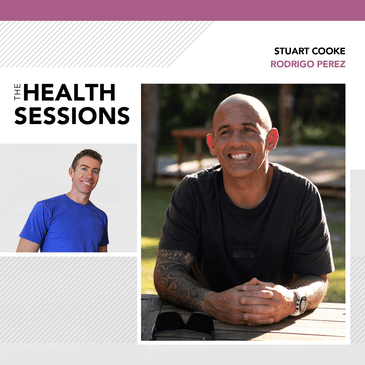
This week I'm excited to welcome Rodrigo Perez to the podcast. Rod has helped and trained countless athletes from professionals and elite performers, through to groms and the everyday athlete. His movement methodology and holistic longevity and wellness approach has helped countless of his athletes improve the way they move, to become more aware of their bodies, improve their nutrition, break through plateaus in their performance and ultimately become the optimal version of themselves.
Over the last 2 decades he has been broadening and deepening his knowledge. Working with multiple modalities to achieve better mobility and precision of movement, better breathing, self-regulation and mind focusing techniques – we continue to help amateur and professional clients achieve their health and performance goals.
Classes, programs, seminars and consultations are focused, professional, challenging, and yet playful – in order to best prepare clients to be the protagonists of their own wellbeing and achievements.
Some questions asked during this episode:- How should we move if we want to live a long and pain-free life?
- What exercises shouldn't we be doing if we have lower back problems?
- How long should we spend on daily mobility?
This week I'm excited to welcome Rodrigo Perez to the podcast. Rodrigo is a performance specialist whose movement, methodology and holistic longevity and wellness approach has helped countless athletes improve the way they move. In this episode, we discuss the importance of mobility if we want to live without aches and pains as we age. We talk about the movements we shouldn't be doing if we have lower back problems, the length of time we should spend each day on mobility and so much more. Over to Rodrigo.
(01:18) Hey guys, this is Stu from 180 Nutrition and I am delighted to welcome Rodrigo Perez to the podcast. Rodrigo, how are you?
Rodrigo
(01:25)
Very good. Yourself, Stu?
Stu
(01:27)
Excellent. It's funny because we met many, many years ago when Guy was involved in the business and I know that he was a good friend of yours. I have been seeing your messages on social media continually for so long and I thought I've got to catch up with you because I can see what you're doing really aligns with a lot of the stuff that our audience is really, really interested in. So, first up, for all of our listeners then that may not be familiar with you or your work, I'd love it if you could just tell us a little bit about yourself please.
Rodrigo
(02:05)
My name is Rodrigo. I've been living in Australia for the last 22 years. Been coaching for 26 years. So I am Spanish, half Brazilian. Mom, is a purely Spanish person, and grew up in Brazil probably half of my life was there, and moved to Australia, was a coach there as well. Finished university there. Then exercise science and I am exercise physiologist. Moved to Australia and had a big goal to first learn English. The funny thing is just know learning the Aussie language. So I still chat with you because I was three years in Australia and I went to London. Over there I had a manager there, and then one of the gymnasiums I was working there as a swim coach. They turned to me and they said, "Where you learned your English?" I say, "Well, in Australia." They say, "No, you learned Australian language mate."
For full interview and transcript: https://180nutrition.com.au/180-tv/rodrigo-perez-interview/
[00:00:00] brought to you by 118nutrition.com.au Welcome to the Health Sessions podcast. Each episode we cut to the chase as we hang out with real people with real results. Hey, this is Stu from 118 Nutrition and welcome to another episode of The Health Sessions.
[00:00:28] It's here that we connect with the world's best experts in health, wellness and human performance in an attempt to cut through the confusion around what it actually takes to achieve a long-lasting health. I'm sure that's something that we all strive to have. I certainly do.
[00:00:43] Before we get into the show today, you might not know that we make products too. We're into whole food nutrition and have a range of superfoods and natural supplements to help support your day. If you are curious, want to find out more? Just jump over to our website.
[00:00:58] That is 180nutrition.com.au and take a look. Okay, back to the show. This week I'm excited to welcome Rod Rigo Perez to the podcast. Rod Rigo is a performance specialist whose movement methodology and holistic longevity and wellness approach has helped countless athletes improve the way they move.
[00:01:19] In this episode we discuss the importance of mobility if we want to live without aches and pains as we age. We talk about the movements we shouldn't be doing if we have lower back problems,
[00:01:28] the length of time we should spend each day on mobility and so much more. Over to Rod Rigo. Hey guys, this is Stu from 180 Nutrition and I am delighted to welcome Rod Rigo Perez to the podcast. Rod Rigo, how are you? Very good yourself. Excellent, excellent.
[00:01:50] It's funny because we met many, many years ago when Guy was involved in the business and I know that he was a good friend of yours. I have been seeing your messages on social media continually for so long
[00:02:06] and I thought I've got to catch up with you because I can see what you're doing is really aligns with a lot of the stuff that our audience is really, really interested in.
[00:02:13] So first up for all of our listeners then that may not be familiar with you or your work. I'd love it if you could just tell us a little bit about yourself please. My name is Rod Rigo. I've been living in Australia for the last 22 years.
[00:02:30] I've been coaching for 26 years now so I have Spanish, have Brazilian, mom a pure Spanish person and grew up in Brazil like probably half of my life was there and moved to Australia. I was a coach there as well, finished university there, exercised science
[00:02:55] and I am an exercise assistant. And moved to Australia and had a big goal to first learn English now and the funny thing is just learning the Aussie language. So I'll chat with you because I was 3 years in Australia and I went to London
[00:03:15] and over there I had a manager there and one of the gymnasium that was working there as a swim coach they turned it to me and I said where you learned your English? They say Australia and they say not you learning Australian language, Mike. Exactly right.
[00:03:36] I said low and clear. As a goal to work what I love, that's very interesting because when I moved here I had so many opportunities to change career. I could be working in mining, I could be working in hospitality
[00:03:59] I could be working in any kind of business now and then but I had this in mine so if I decided to leave it for good in Australia I would love to continue what I said
[00:04:11] and for me I had so much background with fitness, knowing a lot of sports but for reasons. One of the big reasons was health. A lot of problems I had with my health was with the young kids
[00:04:32] we had a lot to be a little obese kids and had to learn how to swim, learn to breathe I had to control my emotions for life. I got a lot of bullying around so all these things just turned into my mind
[00:04:50] how I could treat myself and how I improved and I was learning with my journey in life. My experience took me to know more about the body and keep doing what was doing back in Brazil here in Australia.
[00:05:09] I'm studying more, always looking into big courses, how I could learn the big courses how I could go to Japan, US, Europe, learn all different kind of courses. For me it's very interesting the way I learn and I'm so quickly to digest
[00:05:27] and understand on the bottom of the mat. Now if you have a mat, I have the solution on the bottom, I'm pretty quick on that way. And yeah, I could see the big picture for everyone as a long term
[00:05:42] about exercise, body stability, body strength, spine stability, nervous system. So the many years work in different types of fitness. I don't like talking much about fitness, I like talking about health. At the end of the day, exercise, eat, sleep, hydrate it, it's about health.
[00:06:09] For sure, you need to get fit for this, you need to get fit for that, you need to compete, you need to get fit. But at the end of the day, fitness can be totally different what is healthy.
[00:06:23] But if you get it at the point, if you are healthy, your fitness is going to be very high. And that's why I started to go into more what I could make it a bit more efficient what I was doing and more efficient and precise for my clients
[00:06:42] how they can improve in their way. So how they move better, how they think sharp, how they could step up and things what they love to do. And many, many years I saw it's way more behind than just lift weights.
[00:07:00] So everyone okay, it should be helpful when they lift weights. Yeah okay, but it's a lot of behind there. Now it's kind of long on how is the nervous system, what's the pathway of the nervous system?
[00:07:15] So how is your mind working to connect your body, upper body, lower body, your core? How is your arms moving? How you sense signs for like your fingers and your toes, your leg, which kind of muscle can switch on. It's all the awareness involved.
[00:07:35] And many years I saw different kinds of people. I saw a lot of like he a lot of things happening now a lot of missing in on a human being. Now as as a modern human generation by generation is being changed.
[00:07:54] Now kids don't play more on the street anymore. Kids don't play soccer outside anymore. So everything starts to be dangerous. So like you coming from England, you know how things always change around them.
[00:08:10] Like I mean from Brazil suburbs probably here 23 years and I see all these things change for sure. To be in Australia we are blessed. Okay, we are really, really good spot now we play we can if you will not in the middle of the city or the suburbs
[00:08:28] West suburbs you just close to the beach. You can still run in the sun. You can go for a ride by like yourself, you're in Byron Bay. How many things you have closed by or some other kids can have around.
[00:08:41] No, but as a generation going and the parents we sometimes we get lazy to educate the kids to create all this pathway of the nervous system. Now they can get a bit more mobile, more efficient with the movements or be more connected with their own body.
[00:08:59] Now and sometimes not just play sport you make it that now it's a lot of more behind what's first things for us. Yeah.
[00:09:07] Now and with that I realize that can each you educate my clientele will be different now like in my concept like why should load someone if the person doesn't know how to move properly.
[00:09:20] Now why should load someone if they can or even squat night degree or even though the ninth degree now and how I should why should give you have a person doing a band roll.
[00:09:35] If they know even know how to engage the scapula or if they don't know how to protract retract the scapula now how they can keep the they serve call is stable how they can keep you the thoracic stable.
[00:09:48] And that's what people like in the long term create a lot of dysfunction now because they don't have these awareness or they're not connecting to know but they don't say what is okay what mean connect I move I walk I jump.
[00:10:02] Yeah, but said movements your body is not supple. That's right. That's right because I recently read a book another health book I read these books all the time no doubt same as you but this was talking about it was talking about the whole.
[00:10:18] I guess health as a series of pillars and obviously the big ones were nutrition and movement and but one in there that was kind of interesting for me and I haven't heard of it being spoken about in a lot of detail previously.
[00:10:34] What stability and they were saying that stability is absolutely key and it is core for everything that you do and especially as we age because stability declines. And as you mentioned before it's all very well going into the gym and just lifting weights.
[00:10:51] Just doing these tried and tested movements and then maybe smashing ourselves in a high intensity class and they're getting in a sauna and stuff like that but if you don't understand the fundamentals of what you're actually doing and working on the framework.
[00:11:06] Of stability and movement and flexibility and mobility.
[00:11:10] Then it's kind of we're missing the point and I think that will start to catch up on you as we age because I'm now 51 and I'm realizing that I probably need to do a lot of work on my mobility my flexibility and my stability to try and make myself more robust as I age.
[00:11:31] So my question to you is how should we be thinking about movement then today if we essentially want to live a long pain free life because so many people have got bad back or my shoulders or my hips.
[00:11:45] And of course you go to the gym and you've just got machines and weights and classes and stuff like that but that's where I see that you think so differently and I can see that you're working and training and living with everybody from the weekend warrior to the elite athlete in whatever given sport.
[00:12:04] So what what do you say to those people that are just going to the gym doing the same old worker every single day but perhaps not feeling their best and unsure where to even start. First, it's not sustainability over there. Right.
[00:12:20] Okay. And no doubt that is not sustainability. It on doing this high intensity training every single day is not a sustainability there. Okay. Even some bodybuilders when they get in 50s they keep the mass up but to be honest they all suffer with the back pain. Yeah.
[00:12:41] Cervical to last lower back don't have one or two bone disc they have like four or five six. Right. So bodybuilders probably suffering a lot. No. Only clip is the same. Power lift to be the same too.
[00:13:00] But it's major of people when we talk about this just gym, gym, gym, gym. Okay. Big thing like when I talk about the fish is we're going to talk more is good you mentioned about nutrition. Yeah.
[00:13:13] Because that's all the part I went very holistic and deep into to make all these nerves on the nervous system work properly. I had to go to nutrition as well now because sometimes what you eat can really upset your nerves can really upset the pathway of nerves.
[00:13:30] So the information don't cross over at the same way. Now the pain is like a background of food. How bad do we eat? How much information have in the body?
[00:13:40] How much your gut can like blurt it all the time but we can go more deep in after there. Back to your question. Definitely as you mentioned to your arm go to 50 and into looking to stability mobility and stretch.
[00:13:57] I don't see only yes is big into when you get it for I would say when over 35 is big one 35, 40, 45, 50, 60. But the more people assess the more clients are getting to I see the problem is not only the age.
[00:14:16] This problem is coming to the young age as well. Even a high elite athletes and sometimes they before to see me they've been spending so much time. Doing head weights, squats, the leaves of each press. Now that's the three big ones a lot of people believe.
[00:14:35] Okay you increase the power, increase the strength but that's all doesn't mean they make people supple. It doesn't mean he's gonna teaching my athletes get an e-sqe or make it this day level going to the next step. No and you can put it by all I'm work functionally.
[00:14:54] Okay so the functional training but a lot of people has this concept of a functional training doing a circuit. Yeah four or five, ten exercise and okay let's five exercises okay the squat here either lunges over there. He does lung ball in front of you.
[00:15:11] He doing swings and doing butthole ropes. Yeah and okay we made 30 seconds each you change. You're doing one minute, you have two minutes rest, it's a circuit you change. Well you got all the movement patterns there but you shouldn't work the real movement what you need to.
[00:15:32] Now you don't teach your body to have an e-sqe and then when we work in mobility. Mobility people have tends to think about is a stretch but it's not really a stretch. It's a combination of the muscle flow together with the joints.
[00:15:49] It's an open abeam or area into the joint so we create more range of motion across there. But sometimes you don't need to stretch at the time you probably need to stretch. So you need to strengthen your body in different areas that you haven't ever been.
[00:16:06] So squat tonight degree can you go down deep squats but when you're going down deep squats for a skinny maintain a good posture. What do you mean? Can I keep my spine up and right from the cervical way down to the coccy.
[00:16:26] When you're down there can you hold there for one minute are you strong can you lift from there. So these little things is like we have small muscles around these areas they don't be working probably.
[00:16:40] Now they need to be work then each day strong that area and part of mobility not sometimes just sit and just move the joints.
[00:16:50] You need to flow why because you need to work in a my fashion now so the my fashion release across all these links we have in the body.
[00:17:00] So it's links in my fashion we have across the body so they have to create more movement they have to get a bit more elastic around there.
[00:17:08] And that's we start to create more mobility because otherwise as you say after 50 555 is such a slow your body don't move in that supple anymore. You know because you just lean your work which is squats I just like that.
[00:17:24] That means you know but your body don't be moving different ways. Now so for people like you can do every day definitely it's not sustainability there.
[00:17:33] They should look into working different parts normally had weights normally strength but getting parts of stability before can stability is that strength more body. He worked more than ever systems dangerous and he mentioned mobility as well.
[00:17:49] Now big thing what my view is inside of the media today we have all have to be careful. We have these massive gymnastics and beautiful mobility now they're going deep but they bring the leg up in the head but you probably know how to do that.
[00:18:08] And my part of the people not able to do that. Now people like them they probably took it 10 20 years to do it now they being 26 today 56 years old. So they educate they want to be there but they have to stand a client or who watched them.
[00:18:25] I'm not able to. So what the guys then everybody then is attending a gym a normal regular gym and lifting the weights maybe doing the circuit.
[00:18:37] Should they be thinking about incorporating things like yoga and Pilates into their week or is there are other ways to work on your stability and mobility outside of those two because they're the most common ones right everybody at the gym this they probably got classes to do things but still unknown I think from their perspective.
[00:18:56] All right so if we have to use that to make a schedule for the week. Yes, definitely I would say not spent too much time in the weights for the two three days a week on the weights and other days definitely going to Pilates are going to yoga.
[00:19:13] Okay, also stability work you can do a lot of on the team like my programs you can do a lot of sing like that it's sing like pool sing like push these all different ways while we can do it at the gym and be part of the way training but a lot of stability and get strong as well.
[00:19:34] First because when we work is stability. We need to work a lot of the mind we have to think to do it as a think we have to do it and we see true on every system engage more muscles.
[00:19:46] So we can burn away more energy doing that way than just live to hit like down and then all let's do it so going off so you don't see your mood to switch your core but to work in stability can do it.
[00:20:01] But if you let's say Monday to Friday and say I would say some week Tuesday Thursday we have weights for a big partners there Monday, Wednesday and Friday I was doing some yoga in the morning pilates and a half for the other days.
[00:20:19] And mix up with the card with things that's other thing you should don't be doing long distances, long car is every single day. Now so my I call the micro card is now so like high intensity training people do it like get off.
[00:20:36] I would say doing 10 to 15 minutes high intense but like sprints.
[00:20:41] Now you can do it mean with two top to four times a week after your workouts you can do it straight away and one day a week even for the big card you know so that's what we're going to talk about zone two.
[00:20:55] And how long do you think that we should spend say each day on mobility if we decided that maybe Monday and Thursday are going to be our weight training days.
[00:21:05] And we're going to go for maybe a Tuesday Wednesday Friday to work on that mobility and flexibility component should I mean it would be 30 minutes or is doing do we need a lot longer to really pull push the levers in those areas.
[00:21:20] I would say if you have time like when the programs are built in and going to launch next year they should be every day. If you have time now maybe some days okay I'm just going to serve or just go for running today.
[00:21:37] I should spend at least 20 to 30 minutes and a good routine of mobility. So if you spend this 20 to 30 minutes you can go up to 45 minutes you will be a lot of mobility and yeah at least four days a week I would say minimum.
[00:21:54] And is it do we need any specialist equipment for that or could we do that literally in front of the TV watching Netflix. Definitely. Yeah. I love to do my own Miranda. Every morning as I call the morning routine so we moving the morning glory out there.
[00:22:13] So move all the parts of the body as a mobility now so losing up the neck thoracic heaps spine with the spine scapulas and ankles and all toes.
[00:22:27] And yeah I would say between 20 to 30 minutes if you can do it every day as soon as you get up and that's helps you like one thing like when we talk about courses all levels can really upset you in the morning. Can wake up very tight. Yeah.
[00:22:44] And that's one reason I should like a doing the mobility in the morning now because if you get up in the morning you kind of stressful the day before. You know you're going to be dehydrated.
[00:22:55] You'll be so stressful your console is too high against me when you get up courses all hits very high straight away and it's where you can feel it pretty stiff now and you should spend a little bit time into mobility every day.
[00:23:11] And also mobility it's kind of like any kind of sport. No I see as mobility is sport if you want to get better and proven losing each practice every night. Yeah. That's good that's good advice.
[00:23:22] So thinking about those people that are really focused still on the traditional weight training components so perhaps they've been told that they've got to go in and they've got to use all of the big muscles the compound muscles so they may be doing deadlift.
[00:23:40] They might be doing squats but they have lower back problems.
[00:23:46] So little twinges here and there maybe they got tight hamstrings so they can't really get down properly and are there any exercises that we flatly just shouldn't be doing we shouldn't touch if we do have any sort of lower back issue at all.
[00:24:02] Yeah definitely when you talk about these problems to like two movements you should don't do in the pain to how bad it is. If you're an acute pain first don't bend forward and second don't twist your body.
[00:24:17] So if you have to bend you should squat yeah and if you have to reach you should turn no so turn your body whole body not just twist no because you have the sacrum.
[00:24:28] And we have the S1, L5 on the top if you twist on the top the body don't have to be made it you twist on the top of the L5 S1 as we put a lot of pressure there and really irritate the disc over there.
[00:24:44] And that's probably the most common disc problem people have when they have a lower back pain. So definitely avoid deadlifts in the beginning now definitely avoid I would say squats which you can do but depending on which range it's not depending how bad it is.
[00:25:07] But a big believer is you can do squats on the wall with a Swiss ball giving support from there. You should be able to do a single leg deadlifts as well using Swiss ball as a support.
[00:25:20] Now if you can teach the body the little hinge without like loading but have that it should avoid definitely on the straight back should give it a break. And wait the body get full heal before coming back.
[00:25:40] But you still need to move your body tools to keep a hinge. And movement it's a movement partner we need to have the hinge there and it's one part of the lower back pain people can get very tight around that it cannot hinge as much anymore.
[00:25:57] Or even putting your back stenches is very hard because all the pisces muscles maybe getting flamed there they can type it out there. The core doesn't be working properly as you say tight hamstring glue to switch off now so we need to recruit all these muscles back.
[00:26:18] So it's part of the exercise we can do and you should have the feeling. Yeah it's interesting because even I know that a lot of those movements people say people will say just one second. Oh yeah. Can you do that? You can up a little bit now.
[00:26:42] Thank you. I'm back. Okay, no that's excellent.
[00:26:51] So I was just thinking that especially with a lot of these movements that we're told are very important these big compound movements that people will often do in the gym regardless of whether they're lifting kettle bells to use them or dumbbells or barbells.
[00:27:08] They're always told to engage their core or engage their glutes and often times it's very hard to actually know what it feels like if you engage your glutes and I say well how do I engage my glutes? I've got no idea. Do I squeeze my bum?
[00:27:27] What am I supposed to do?
[00:27:30] What tips could you provide to ensure that at least if we're going in and doing these movements we're going to be as safe as we can and we are engaging the right muscles because it's such a mystery to me to try and engage a set of muscles that I really don't know anything about
[00:27:50] and I don't know how to engage them. If I'm engaging them, I don't know perhaps I'm setting myself up for potential injury by just not doing the right thing. Definitely it's set up with the movements.
[00:28:06] A specific exercise you can do to teach your body to engage the muscles. Sometimes engage your muscles doesn't mean squeeze their glutes. Your muscles have to switch on when you apply movement. You have to say I'm going to run.
[00:28:26] I'm going to do gyms in order to strengthen my muscles but switch on my muscles, teach my body to switch on because when I'm going to run and I don't have to think that it will switch on and support me to my sport.
[00:28:40] That's what I'm talking about before. I'm never going to load someone if the person doesn't know how to move properly. If they don't have a system, they don't know how to talk with your muscles. If you don't have this awareness in their muscles.
[00:28:56] It's pretty hard getting the positions to do it. We talk about the core. We have two different types of core. We have embrace the core that's more out. That's why they show in these days to have less support to do movements.
[00:29:12] But when you join the body body in, it's a lot of isometric training. It can be two different ones because sometimes creating this stress on the core or really switching on the core very hard and very hard to lift is all.
[00:29:31] But you need to know how this core can pacific switch on, brace to make it happen. That's a big opinion and definitely we need to go towards to neuro-muscular training. When we talk about neuro-muscular training, mobility is like neuro-muscular training.
[00:29:53] How we have to move in certain areas to switch on more and stay more. That's when we go to the component called moral control. Everyone is allowed to do faster.
[00:30:08] No one is allowed to do a little bit slower, stand up by the movement or work more centric face to educate the body. The big thing is when we start with light whites and depends on how many reps you're doing.
[00:30:23] If you're going to be heavy or say 8% if you're doing kettlebells, you should not do too many reps. You should do one or two reps or maybe doing 10 sets.
[00:30:34] I don't know if you want to work harder but at least you are teaching your body, mastering the movement, you educate the muscles, switching on be more. I know that it's great to watch videos online.
[00:30:51] Goal state would be to book a class or session or a consultation block with somebody like yourself that can literally guide you through all of those movements so you can get an understanding. It's so hard to try and read about these things and then put it into practice.
[00:31:08] Now you've got a number of different programs. The Holistica Academy I'm particularly interested in understanding more about and then I see workshops and retreats so you're doing a whole heap of stuff. If I really wanted to work on my movement stability, mobility, flexibility, all of those things,
[00:31:28] would the Holistica Academy be a pathway to be able to actually understand all these things from an online perspective? Yes. Yes, the Holistica Academy would be the best. So over there we have all the programs we put over there. People can have access to everything you can.
[00:31:47] We have a program that's called the Reset Program. That's when we talk about the mental muscular work. How about your embrace decor? How each movement should do it? That's what you should do to get it in the morning to get with your mobility work.
[00:32:03] So we have a program that's called Morning Routine, what you should do in the morning. So we have a routine with me between 7 minutes to up to 25 minutes or 30 minutes. Now how are we going through it together? I'll set myself for mobility.
[00:32:18] So these two programs, if you engage in one of each of each in the morning, give me years there, doing it for 30 days and let me know how you're going. I bet you're going to feel any way better tools to do your weight training.
[00:32:33] If you're going surfing, if you're going running or jiu-jitsu, Brazilian jiu-jitsu, swimming, you're going to feel any way more engaged there. We have parts, I build some parts with just body weight strength as well
[00:32:49] so people can get a bit more smart what to do for legs or upper body, using bands and kettlebells. We have a breathing pathway so what people can learn how to breathe, how they can activate more of the diaphragm. And that's a big problem for everyone.
[00:33:07] A lot of people don't know how to switch on the diaphragm, how they can create more stability using the diaphragm. The diaphragm is a big one because as you talk about deadlifts, running, squats, we talk about the pelvic floor, how I can create more stability.
[00:33:23] My pelvic floor doesn't create damage and diaphragm is one of the big ones. So yeah, I suggest going to my Holistic Academy. You have a lot of stuff there and then every month we launch anything there. Okay, fantastic.
[00:33:40] And for our listeners that wanted to dive into that today, where would be the best URL to take them? Alright, so if you're anyone that would like to know a little bit more, a lot of tips every single day, definitely go to my Instagram.
[00:33:55] It's called Holistic for Health. And Instagram, Holistic for Health. You guys can jump on my website, it's called Holisticph.com. Anyone, if you'd like to send me a message, you can send me to Instagram. Can take one or two days to answer,
[00:34:13] but at the moment if you're answering all the messages, it's okay. Otherwise we have some free training and a YouTube channel called Holistic for Health. Also can jump in there. The retreats are pretty nice. So the retreats you use 10 days full experience between mobility, movement, stability,
[00:34:37] surfing, hiking, meditation with Tom Cairo. That's very good experience. Our first or next one will be on 27th of April to the 6th of May, 2024 in Sumba. Two, you're more than welcome. Alright, you come and mine, you should come. Beautiful there.
[00:35:00] Yeah guys, and I have a big surprise for next year now. So I'm just working on this big project. Fantastic. Yeah, so I'll have the new project coming. Well, I'll put all of the links to everything that you've said in the show notes,
[00:35:16] but I'm keen to dive into, you mentioned nutrition at the start of the conversation and how you thought that was super important. Just in terms of one of the pillars that can really move the dial, I guess to decrease inflammation, to give you more energy,
[00:35:32] to allow you to sleep better, and when all of those things are in place then life generally is going in the right direction. What are your thoughts given the fact that, again, it's so confusing? So low carb, everyone's pushing low carb and keto,
[00:35:50] and then we've got everything from vegan all the way through to carnivore and everything in between, intermittent fasting. And a lot of these particular diets that could be trending or fat diets are going in and out of popularity.
[00:36:08] Keto was huge a couple of years ago, and then people were saying, well maybe it's not so good long term intermittent keto perhaps. Maybe we need to reintroduce carbohydrates. Some people are saying that well, carbohydrates are not a good idea.
[00:36:24] Where do you sit in this big world of confusion and nutrition? Because I know that you're putting it into practice so I'm keen to hear what the experts think. That's pretty cool you say now is there confusion there.
[00:36:37] I think like it's a confusion, it's marketing, it's an ego, it's a media, the best. So at the end of the day there's too many things and we have to simplify. And also what is the sustainability behind that?
[00:37:00] Then we talk about keto, carnivore, vegan, vegetarian, what's the stability behind all that? What do we see? What nots between carbs and carbs? Yeah we need carbs. I think it depends which carbs we have. A lot of places in the world, I think a big problem is coming.
[00:37:26] A lot of pasta, pizza, breads, white rice, I think that's a big problem in that area and a lot of sugar as well. So all these turn into sugar and I think that's a big problem for a lot of people.
[00:37:41] And when you talk about dairy as well could be a big problem. Because of the quality of milk you get and what's people getting from the shop is. Sometimes I know these guys, they talk in the media as one's vegan, plant based, like carnivore or get raw milk.
[00:38:02] But sometimes you have to see how is the reality of everyone around. If you want to be a good educator you need to see what's the good sustainability for everyone. You yourself create your supplements now to help people and help you.
[00:38:18] And that's why we need to understand what I need to know, what is my stage? What should cut off what upset my body? Like today I know what upset my body.
[00:38:27] I know what I want to eat too much. Every year I try to get it between probably April to August. It's kind of like the month I start to get close to the winter.
[00:38:39] I try to be peace everything. I persist every year with them to see what's going on. And I know what I have to cut off. I know what I cannot eat all the time or maybe just muscle.
[00:38:52] It is what can upset my gut or make me put a lot of fat around my waist. I really can't upset my cholesterol, things like that. So when we talk about the exercise healing process diet is just so important. It's way more important than our proper treatment.
[00:39:14] A treatment definitely helps relief and improve but treatment at the end of the day is kind of like a bondage. You just put a bondage on the top doesn't mean that's a full heal. And your body can really create these bad habits just leaving from treatment.
[00:39:37] Now I have pain. I do this, my treatment feeling better next week. Feeling pain again during treatment. So it persists something is not sociability that is not full healer. It's not complete correct. So when you talk about the pillars of someone in part habitation or build back.
[00:40:01] Nutrition is a big one. Nutrition, lifestyle, sleeping pattern, hydration, food. A lot of food creates the inflammation in the guts can create a lot of stop the pathway of the news. All the information across the body, all that, the area can heal properly.
[00:40:25] So what would you say then to people that are concerned about carbohydrates? Because I know that this is the big one in sports and performance. Carbohydrate is thought to be the most important source of fuel for athletic performance.
[00:40:42] And irrespective of whether you are a top tier athlete or a weekend warrior, somebody like myself that just likes to go to the gym two or three times a week. We are bombarded and told that low carb, low carb, low carb, no carb.
[00:40:56] And you mentioned that it's important to consume carbohydrates. So what do you personally do? First my main carbohydrates come from fruit and veggies. Veggies, sweet potato, let's say I don't eat less salads sometimes. I'm kind of forcing, I don't like to be just one thing.
[00:41:25] I like to be able to be a big believer in more Mediterranean diets and fighter diets. So these two diets, I think today you have a lot of sustainability there. But a lot of my grains sometimes, my veggies, I do have meat.
[00:41:42] So why if you ask me, I'm all positive, that's my blood type. It needs a lot of meat. I try to eat a lot of meat. I try to bring some white meats as well. Like I do prefer to have white meat at night time.
[00:41:58] I can sleep way better. I prefer to have fish. I prefer to have eggs or sometimes even tofu. In fact, I say no to that. It's not something I have all the time. You get tofu, tempeh, I don't have all the time.
[00:42:14] Maybe once a month, maybe twice a month. But often I have between chicken and fish. That's why I try to have it at night times. All the fatty meats I try to have during the day. Now it's probably three o'clock in the afternoon.
[00:42:31] Let's say probably, but I try to get a lot of quinoa. Sometimes I would say maybe three times a month. I'll probably have some rice between white rice and brown rice or black rice. White rice just if you're going to any Japanese restaurants.
[00:42:52] My partner is a Japanese resident. We educate our daughter with a lot of Japanese food. She loves sashimi. She's really can be very carnival eating sashimi and meat. That's her and fruit. So I do myself on that area.
[00:43:14] I know for me I cannot eat a lot of dairy. The only dairy I can have is a goat milk or goat cheese. Because it's two different types of cousin. Cousin one, cousin in top two. Cousin in top one, it's a lot of very inflammatory.
[00:43:33] And top two, it's no much inflammatory. It's a bit more mellow. I love goat cheese. They're pretty yummy. I try to get a little bit more fat. So I eat probably one avocado a day. So the ice is pretty much balanced between around 60% fat and protein and 50% carbs.
[00:44:03] My carbs just weigh more between a lot of foods. I love red papaya. I like sweet potatoes. I like to make mashed potatoes, sweet potato. So I touch and blend my plate like this sometimes.
[00:44:23] A couple of times in a month I had a piece of gluten free bread. Very high quality bread. I can have one or two pieces of that but it's not often. It's very, I'm not like people sometimes think I'm carnival but I'm not. And that's what I'm saying.
[00:44:46] I'm way too small palio in Mediterranean diet. Now I have some olives sometimes because they hide fats. You know, I might probably be a very small ball salad when I eat salad. And I like to put some olives there because I want more fats.
[00:45:05] I want to have more protein and olives can give you that for me. But yeah, that's how I work a little bit in my other nutrition. Well that's good to hear.
[00:45:16] So we're coming up on time but I'm keen just to dive in again to your personal habits a little bit more. Just on the final question. And it's about your personal non-negotiable habits that you do each and every day
[00:45:31] that allow you to absolutely win the day, to crush the day. And it doesn't have to be movement related. It could be sunlight or gratitude, journaling, sauna, ice, sleep routines, whatever it is. What are those things that you just do on automatic pilot every day
[00:45:51] just because you know that they make you feel fantastic? Smile. Yeah, no one said that right? No one has ever said that. It's not a big thing like get up and smile. It's a big clock there. And I think your day started there.
[00:46:08] So you allow me to ring, even if you allow me to, I need you all let's go surf or let's go to do the weights or let's jump on the ice. Now it's just smile, turn around, stand up from bed, glass of water, toilet, movement, read, meditation.
[00:46:31] But the first thing I cannot miss is definitely my big smile. I think that just it will make your day. If you get up in a straight away and you're like, damn, I have to do this. Oh, I have that meeting because people have tennis there.
[00:46:46] How many times you go up in the morning and say, Oh, I cannot forget about this guy. I cannot forget about this one. That's right every day. That's it. We switch on, well we get up, we switch on our phones and then before you know it,
[00:46:58] the phone is in charge. Yes, it is. So for me, it is just turning my back, whatever happened, I just put his smile on my face. Now that's just a little habit like simple and then because we have to train them on and this might help so much
[00:47:16] and you have to train the nervous system as well. As soon as you're doing that, you keep a big, a big, shiny and beautiful longevity energy around you as soon as you get up. Whatever happened after this smile, your smile will come back because the gratitude is there.
[00:47:35] So you give it this smile, it's ready as a gratitude for what you have. No, it's good. It's great to hear. No one has ever said that and it makes so much sense. Yeah, it is. That's why we pretty much remember when I was studying
[00:47:51] and looking to what's behind, to go for a free sense for our day, a free sense for performance in the athletes or be efficient to make a coffee, you don't know me. Like how many people get out of bed so cranky, so they put the coffee outside.
[00:48:11] Oh, it smells. Oh, now I'm happy because I have my coffee. It's all like that. No. It's just addiction. No, at the same time, it needs to be like yourself. There is addiction. Yeah, that is an addiction. But my coffee, I have it after I'm doing everything.
[00:48:31] I don't touch the jug, I don't touch the machine, I don't touch nothing to the time. Like get up, big smile, I'm stream bad and my people looking aside like every night my little one jumped ahead that for three o'clock in the morning
[00:48:47] photo course you jump in the middle. Sometimes they get up and you can decide how things straight away in my nose or I look at you just laughing now. And I say, oh, little one. That's right. Yeah. So I tend to run it just because sometimes
[00:49:02] you put into yourself things like that can really upset you. If you get up and all this probably here, this shit there, what are you going to do it? Mine. You know, they start from that. Yeah. If you have this in your mind, you'll be hard for yourself
[00:49:19] to deal with if you're in stress. That's a big point. That's what we try to, does it matter if you meditate or not? You know what I mean? For sure, meditation helps you to solve dealing with problems way back. Yeah.
[00:49:35] But it's all about how you get up in the morning. How you put yourself out there. Yeah. No, that's pretty. Meditation. Very good advice. Very good advice indeed. No, that's fantastic. Well, Rodrigo, we're kind of there. We've finished. There's one point for you. Don't forget it.
[00:49:54] Guys, a big surprise. So next year we launch my first book and my word. I, they're going to say what's the title is a big surprise. Yeah. You need it. And everything that we spoke today is going to have that
[00:50:13] in plus now everything what's even people where to gym every day or how she doing and how he schedule like everything a big side. Well, promise me then that when the book is ready and the book is launched that you come back on the podcast and we
[00:50:30] can talk about it because I'm very, very keen to dig into that because I know I've spoken to a lot of people that have launched books and they said it is a labor of love. Like it's something that has commanded so much time and
[00:50:41] they've put all their energy and passion into it. And I love to talk more about that for sure. And that's how you want. Even for me. Yeah. I learned Portuguese. Yeah. But now everything English. I'd say it was a divider. It was a massive divider, a massive journey.
[00:50:58] Oh my word. That's fantastic. I'm so excited for you. I can't wait for that. Now one thing that people say, oh, you hate now. I know there's a lot to say yes. But then the one they build something a little bit
[00:51:09] extra love in the heart and maybe maybe I'm really looking for the next. And what around what date will we be looking at seeing that on the shelves and in the stores? We're looking to end off March. You start to press sales. Yes. So say first of April.
[00:51:31] Great. May be able to start to buy. Fantastic. Great. Well I'm going to lock you in the diary then for that time because I want to talk more about that. Very excited. Fantastic. Rodrigo, it has been a pleasure to dig into some of your knowledge and wisdom today.
[00:51:50] So thank you so much. All of the links that we've spoken about will put in the show notes and then our listeners will be able to follow you and dial into your message and connect with you on those platforms. But certainly for me, thank you so much.
[00:52:02] I really enjoyed the conversation. Thanks to you. It was very cool. Thanks for listening to our show, The Health Sessions. If you would like more information on anything health from our blog free ebook or podcasts, simply visit www.180nutrition.com.au.
[00:52:34] Also if you have any questions or topics you would like us to see covered in future episodes, we would really love to hear from you. Simply drop us an email to infoat. 180nutrition.com.au. And if you listen to us through iTunes
[00:52:46] and enjoy the show, we'd really appreciate a review in the review section. So until the next time, wherever you are in the world, have a fantastic week.